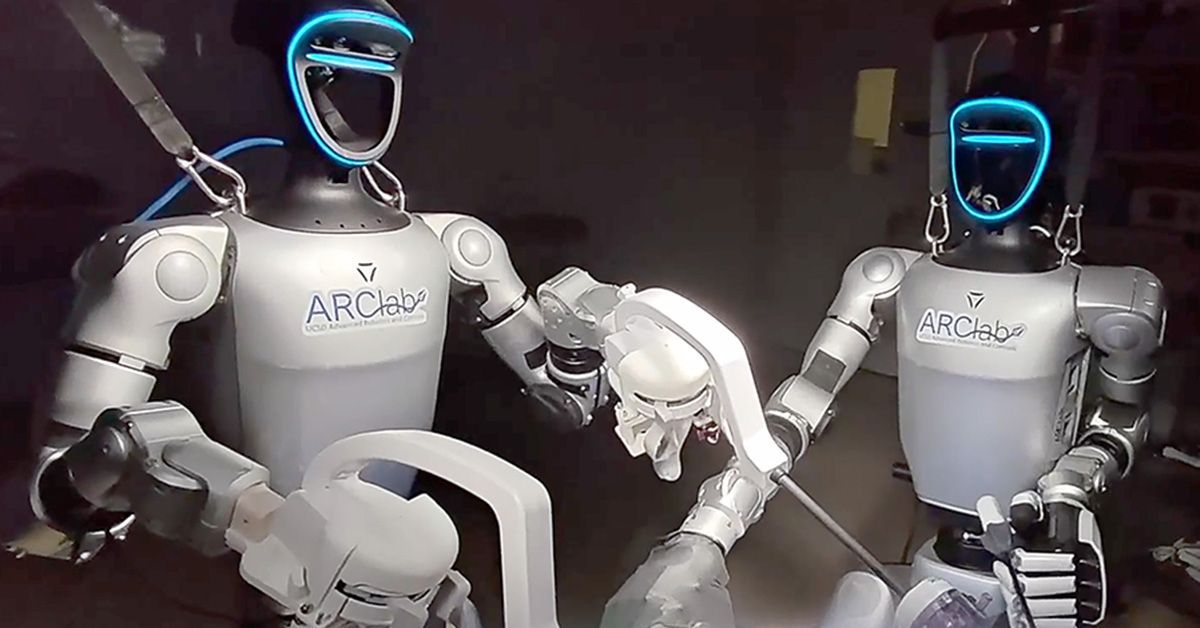
Surgeons Use Teleoperated Humanoid Robots to Perform Live Surgery – a World First
On Jul. 8, 2026, a team of surgeons at the University of California San Diego report that for the first time, two teleoperated humanoid robots have been used to complete two surgeries during a preclinical trial. researchers. The study was published in the journal Nature.
In one surgery, a human-robot team made up of a humanoid robot and a human surgeon acting as an assistant successfully performed a gallbladder removal. A second successful surgery was performed by two humanoid robots working side by side in a robot-robot team. Both procedures were performed on large non-primate mammals.
The proof-of-concept experiment is a first step toward introducing humanoid robots in the operating room, researchers said. These robots could first assist during procedures then later perform surgeries while teleoperated by surgeons.
There is a shortage of surgeons in parallel with growing patient needs, which leads to longer wait times, reduced access and greater healthcare disparities, said Michael Yip, a faculty member in the UC San Diego Department of Electrical and Computer Engineering and one of the paper’s senior authors. “Remotely operated and autonomous humanoid robots have real potential for amplifying access to critical surgeries to which patients would otherwise not have access. This can help address the healthcare crisis not only in the United States, but also worldwide.”
Unlike specialized robotic surgery systems that can only perform one function, humanoid robots are versatile and could be used to perform a wide range of procedures and general tasks, the researchers said. These robots also are easier to deploy in remote areas and other challenging environments, where versatility is important.
Specialized surgery systems are typically equipped with three or four robotic arms, specialized tools and proprietary software. These systems weigh about 1,800 pounds, require a large team to set up, and take up a significant footprint in operating rooms, which usually need to be retrofitted to accommodate them. By contrast, humanoid robots are mobile and more compact. The robots used in this study, nicknamed Surgie, are 5 feet tall and weigh 60 pounds. These relatively light, compact robots are especially useful in remote, under-resourced areas. Building specialized operating rooms for robotic surgical systems or finding large teams to operate a specialized piece of equipment would be prohibitively expensive in these settings, Yip said.
Several issues with teleoperation still need to be addressed. The robots had to be recalibrated several times during surgery. As a result, the procedures took much longer than when performed with existing specialized surgical systems. But this was also common with early-stage specialized robotic systems as well and will likely get better with time, Liu said. The first robotic laparoscopic surgery took six hours; it now takes 30 minutes.
Tags:
Source: University of California, San Diego
Credit: