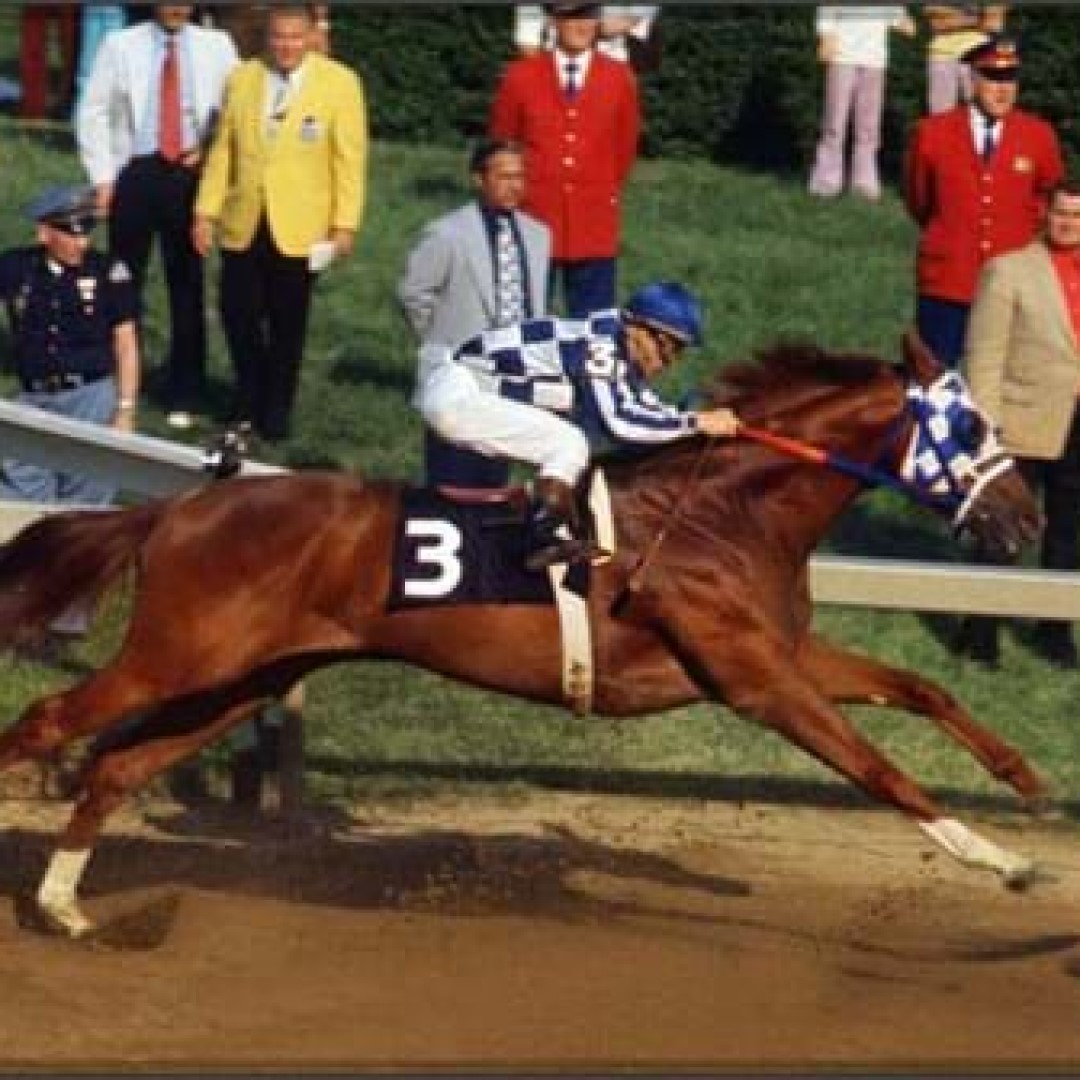
Secretariat won the Kentucky Derby in record setting time
On May 5, 1973, Secretariat won the Kentucky Derby in a record setting time of 1:59 2/5, a record that still stands today. Secretariat, the record setting winner of the Triple Crown in 1973, had a heart estimated to be 22 pounds or two-and-three-quarters times as large as that of the average horse which is approximately 8.5 pounds. Secretariat’s large heart can be genetically traced to the legendary Eclipse, foaled on April 1, 1764 in England for the Duke of Cumberland. The larger heart is passed down the female line on the X chromosome.
As the name suggests, the X factor only mutates on the X chromosome, which all horses (and humans, and ducks and all other animals) inherit from their mother. Males have an X and a Y chromosome, while females have two X chromosomes. When a foal is born, it receives one of its dam’s two X chromosomes, and depending whether it gets its sire’s X or Y chromosome will determine if it is male or female. The result is that there will be few male carriers, and even less males that actually manifest the mutation. This means that a stallion cannot produce hundreds and hundreds of foals with this mutation, only a broodmare with the mutation can produce sons or daughters that will be affected.
Secretariat’s dam was a mare named Something Royal, and her sire, Princequillo, is considered one of modern racing’s primary carriers of the x factor gene, but only his daughters will make foals with the enlarged heart. Writer and founder of the theory, Marianna Haun, originally traced Princequillo’s X factor as far back as a mare born in 1837, named Pocahontas. After verifying Pocahontas with scientific researchers, veterinarians, and thoroughbred breeders, they were able to take the line even further back, first to famous stud Eclipse born in 1764, and then finally to the very earliest traceable ancestor who carried the large heart gene, Hautboy, one of the founding thoroughbred bloodlines in the mid-seventeenth century.
Hautboy would have gotten the mutation from his dam, known to the ages only as “Royal Mare,” which historian Alexander MacKay-Smith says refers to the hundreds of royal mares that were bred by Lord James D’Arcy around 1660. D’Arcy was appointed by Charles II to oversee the Royal Stables and expand a breed of racing horses for England, and the Royal Mares and Hautboy were among these foundation bloodlines. Unfortunately, these royal mares were the end of the road for TB historians looking for the X factor, when the mares had no names.
In contemporary racing history (early 20th century to present) there are four thoroughbred racing stallions considered to be major carriers who would have produced X factor horses: Princequillo, who was already mentioned in the lineage of Secretariat; War Admiral, from his dam Brush Up out of Sweep, (Sweep would later produce large hearts in Seattle Slew and Whirlaway); Blue Larkspur, who made a few large-hearted European champions; and Mahmoud, whose X would be carried down to racing and breeding great, Northern Dancer.
Editor Note: Since 1973, other Triple Crown winners with the X Factor include: California Chrome (2014); American Pharoah (2015); and Justify (2018).
Tags:
Source: The Horse Nation
Credit: Lorraine Jackson for Horse Nations and her X Factor analysis.