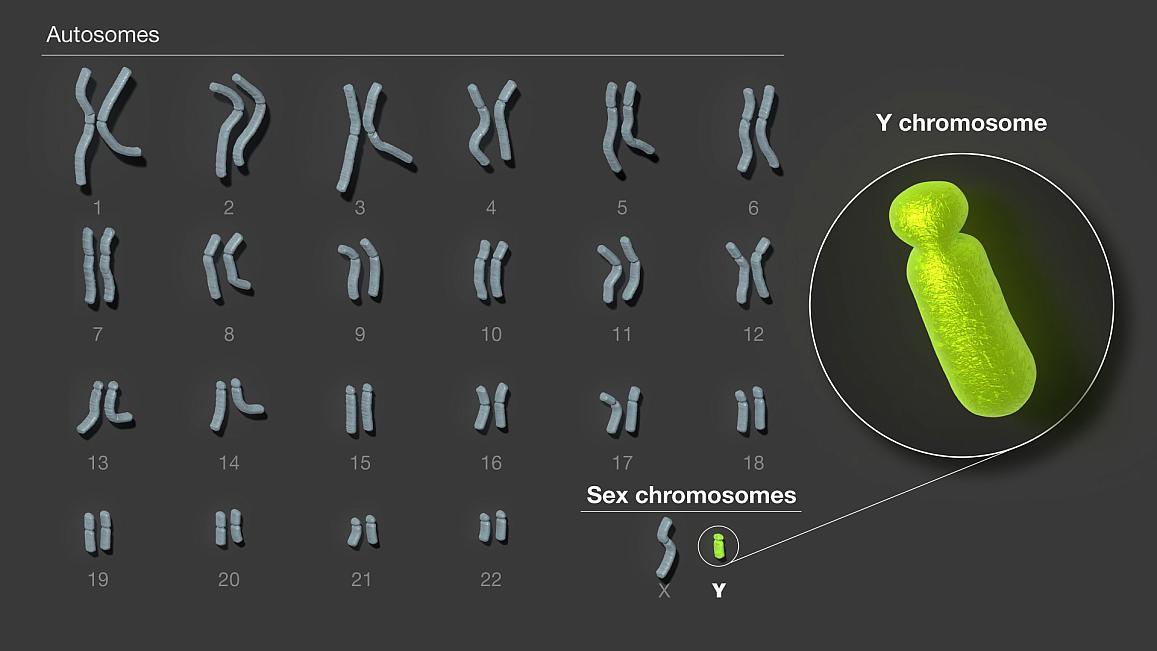
Scientists released the first complete sequence of a human Y chromosome
On Aug. 23. 2023, researchers co-led by University of California, Santa Cruz Assistant Professor of Biomolecular Engineering Karen Miga, announced that the genome of the Y chromosome had been fully sequenced, a feat that finally completes the set of end-to-end human chromosomes and adds 30 million new bases to the human genome reference, mostly from challenging-to-sequence satellite DNA.
The Y chromosome is most commonly associated with individuals assigned male at birth, but may be found in others, such as intersex people. The sex characteristics regulated by DNA on the Y chromosome are also not equivalent to an individual’s gender identity.
When scientists and clinicians study an individual’s genome, they compare the individuals’ DNA to that of a standard reference to determine where there is variation. Until now, the Y chromosome portion of the human genome has contained large gaps which made it difficult to understand variation and associated disease.
The structure of the Y chromosome has been challenging to decode because some of the DNA is organized in palindromes – long sequences that are the same forward and backward — spanning up to more than a million base pairs. Moreover, a very large part of the Y chromosome that was missing from the previous version of the Y reference is satellite DNA – large, highly repetitive regions of non-protein-coding DNA. On the Y chromosome, two satellites are interlinked with each other, further complicating the sequencing process.
The researchers were able to achieve a gapless read of the Y chromosome due to advances in long-read sequencing technology and new, innovative computational assembly methods that could deal with the repetitive sequences and transform the raw data from sequencing into a usable resource. These new method assemblies allowed the team to tackle some of the particularly challenging aspects of the Y chromosome, such as pinpointing precisely where an inversion occurs in a palindromic sequence — a technique that can be used to find other inversions. The methods established in the paper will allow scientists to complete more end-to-end reads of human Y chromosomes to get a better understanding of how this genetic material affects the diverse human population.
This paper finds evidence that about 5,000 bacterial genomes in a common database likely contained contamination matching human Y sequences. The groups studying these bacterial species can use the updated Y reference to correctly remove all human contamination from their reference genomes and get a clearer understanding of the bacterial genome.
While the complete human Y chromosome will open the door to many new discoveries, the researchers plan to further improve the study of this region by including the Y chromosome in future versions of the human pangenome. The pangenome is a new reference for genomics that combines the genomic information of multiple people from various ancestral backgrounds to ultimately enable more equitable research and clinical discoveries such as helping to diagnose disease, predict medical outcomes, and guide treatments. The study was published in the journal Nature. The complete, annotated Y chromosome reference is available for use on the UCSC Genome Browser and can be accessed via Github.
Tags:
Source: University of California, Santa Cruz
Credit: