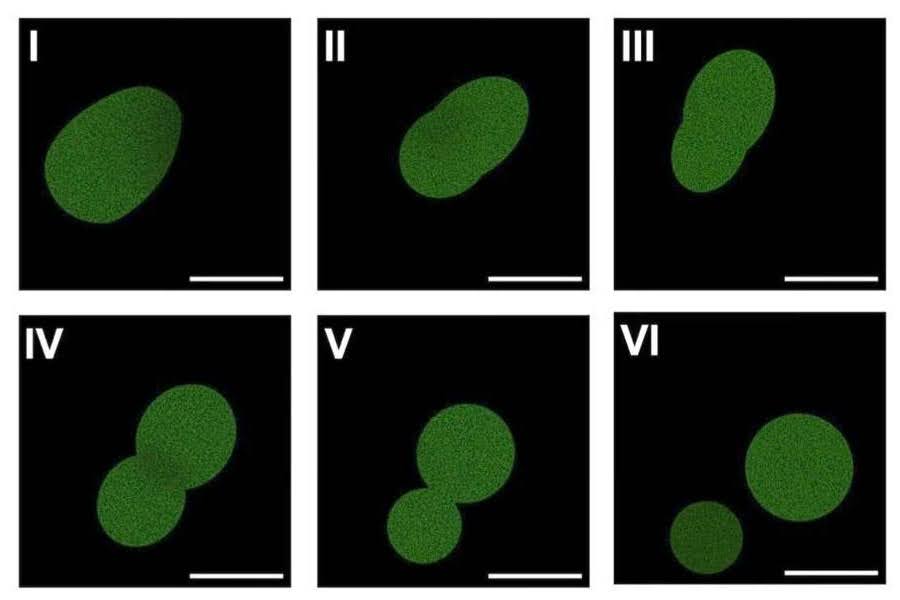
World’s first synthetic cell with a complete life cycle could revolutionize biological engineering
On Jul. 1, 2026, Associate Professors Kate Adamala and Aaron Engelhart and their teams at the College of Biological Sciences at the University of Minnesota (UM) have developed the world’s first synthetic cell with a complete life cycle, built entirely from non-living chemical components, and described it in a new paper. The project, called SpudCell, marks a major breakthrough in biological engineering. In time, it may provide solutions to some of our most challenging problems in medicine and engineering.
Among the characteristics of SpudCell:
- Replicates a biological cell’s life cycle: SpudCell is capable of selection, genome replication, growth, resource acquisition via feeding, and genetically encoded division.
- Cell division without a cytoskeleton: Natural cells divide using internal scaffolding called a cytoskeleton, which has been a bottleneck in synthetic cell research. SpudCell sidesteps the need for a cytoskeleton with proteins that crowd together on the membrane surface until the mechanical stress makes the membrane split.
- Selection and competition: Researchers introduced a genetic change that increased production of the fusion protein, resulting in cells that grew faster and produced more offspring. After five generations, the faster-growing variant had outcompeted the original. Under nutrient scarcity, the advantage increased, demonstrating selection and competition operating in a fully synthetic chemical system.
DNA is the programming for all living organisms. A human genome is roughly 3 million kilobase pairs (kbp) in size. Biologists had speculated that the genome for a living cell could be as small as 113 kbp, but SpudCell’s genome is even smaller, at 90 kbp. Rather than a single chromosome, the genome is split across seven separate DNA plasmids. This modular structure allows the team to “program” various functions of the cell independently. With continued development, SpudCell and its successors will be capable of increasingly complex functions and behaviors.
With the release of the paper, Adamala and partners outside of the University are launching Biotic, a public-benefit research and engineering institution that aims to build the shared technical infrastructure for synthetic cell engineering, and to keep it open for the participation of researchers around the world.
Tags:
Source: University of Minnesota
Credit: Image: Fluorescent microscopy of SpudCell – a synthetic cell assembled entirely from non-living chemical components – undergoing division. Courtesy: Kate Adamala, Adamala Lab, University of Minnesota.