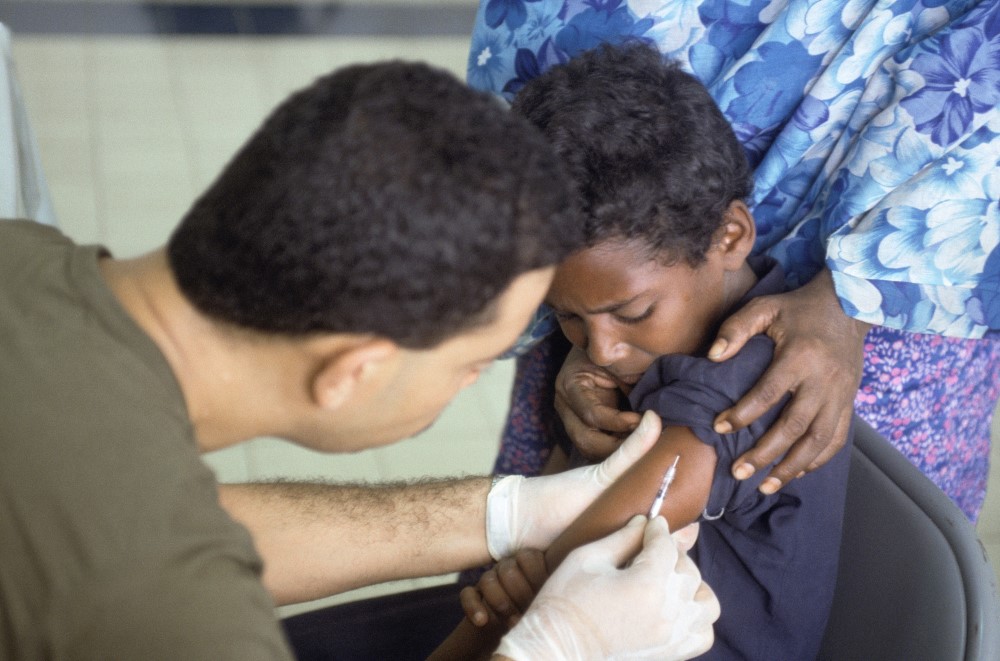
WHO and UNICEF warn of a decline in vaccinations during COVID-19
On Jul. 14, 2020, the World Health Organization (WHO) and UNICEF warned of an alarming decline in the number of children receiving life-saving vaccines around the world. This was due to disruptions in the delivery and uptake of immunization services caused by the COVID-19 pandemic. According to new data by WHO and UNICEF, these disruptions threatened to reverse hard-won progress to reach more children and adolescents with a wider range of vaccines, which has already been hampered by a decade of stalling coverage.
Due to the COVID-19 pandemic, at least 30 measles vaccination campaigns were or are at risk of being cancelled, which could result in further outbreaks in 2020 and beyond. According to a new UNICEF, WHO and Gavi pulse survey, conducted in collaboration with the US Centers for Disease Control, the Sabin Vaccine Institute and Johns Hopkins Bloomberg School of Public Health, three quarters of the 82 countries that responded reported COVID-19 related disruptions in their immunization programmes as of May 2020. The reasons for disrupted services vary. Even when services are offered, people are either unable to access them because of reluctance to leave home, transport interruptions, economic hardships, restrictions on movement, or fear of being exposed to people with COVID-19. Many health workers are also unavailable because of restrictions on travel or redeployment to COVID response duties as well as a lack of protective equipment.
Progress on immunization coverage was stalling before COVID-19 hit, at 85 per cent for DTP3 and measles vaccines. The likelihood that a child born today will be fully vaccinated with all the globally recommended vaccines by the time she reaches the age of 5 is less than 20 per cent.
In 2019, nearly 14 million children missed out on life-saving vaccines such as measles and DTP3. Most of these children live in Africa and are likely to lack access to other health services. Two-thirds of them are concentrated in 10 middle- and low-income countries: Angola, Brazil, Democratic Republic of the Congo, Ethiopia, India, Indonesia, Mexico, Nigeria, Pakistan, and Philippines. Children in middle-income countries account for an increasing share of the burden.
There has been some progress. Regional coverage for the third dose of DTP in South Asia has increased by 12 percentage points over the last 10 years, notably across India, Nepal and Pakistan. However, that hard-won progress could be undone by COVID-19 related disruptions. Countries that had recorded significant progress, such as Ethiopia and Pakistan, are now also at risk of backsliding if immunization services are not restored as soon as feasible.
The situation is especially concerning for Latin America and the Caribbean, where historically high coverage has slipped over the last decade. In Brazil, Bolivia, Haiti and Venezuela, immunization coverage plummeted by at least 14 percentage points since 2010. These countries are now also confronting moderate to severe COVID19-related disruptions.
Tags:
Source: World Health Organization
Credit: