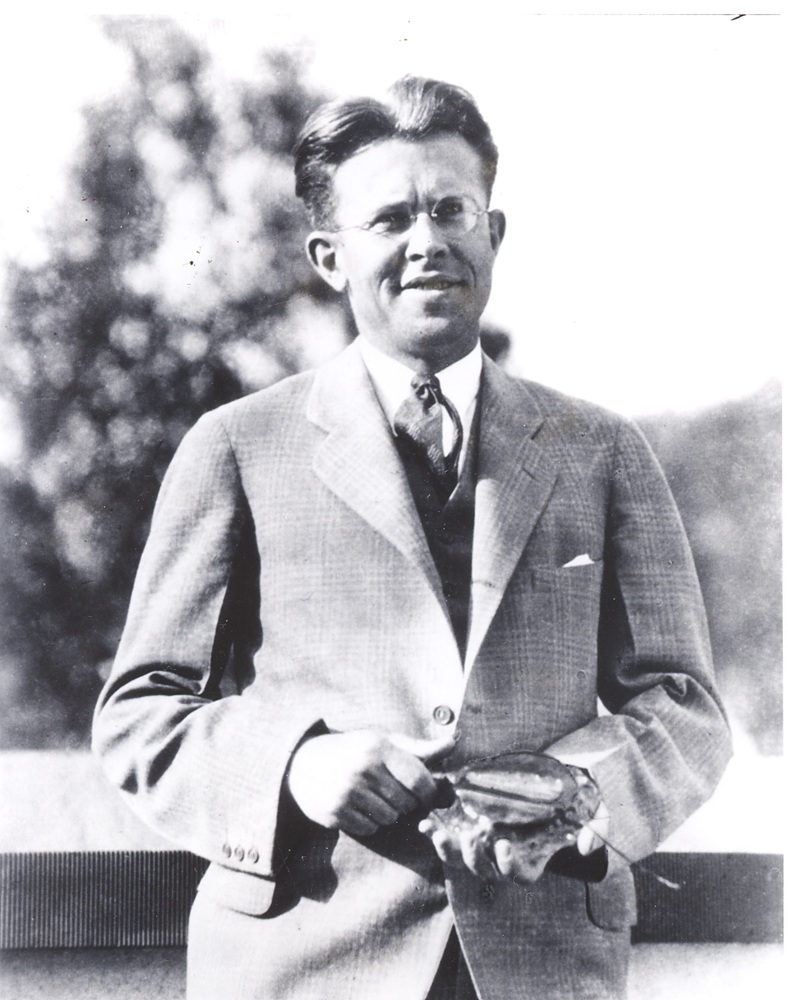
The University of California Radiation Laboratory (Livermore) was founded
On Sept. 2, 1952, the University of California Radiation Laboratory, now known as the Lawrence Livermore National Laboratory (LLNL) was founded as part of the University of California, Berkeley Radiation Laboratory on the one-square-mile site of a World War II naval air training station. In 1958, after the death of E. O. Lawrence, the Livermore Lab was renamed Lawrence Radiation Laboratory.
The Lab’s legacy began in the summer of 1928, when a 27-year-old physics professor named Ernest O. Lawrence was wooed from his faculty position at Yale University to a job at the University of California’s Berkeley campus. While at Berkeley, Lawrence invented a unique particle accelerator called a cyclotron which would prove his hypothesis: whirling charged particles around to boost their energies, then casting them toward a target is an effective way to smash open atomic nuclei. The cyclotron would go on to win Lawrence the 1939 Nobel Prize in physics and usher in a new era in the study of subatomic particles.
Through his work, Lawrence launched the modern era of multidisciplinary, team science. In August of 1931, when he created the Radiation Laboratory in a modest building on the Berkeley campus, Lawrence began recruiting a brilliant circle of colleagues from physics, chemistry, biology, engineering and medicine, whose groundbreaking teamwork would be critical to the laboratory’s legendary success. When his plans for bigger and better atom-smashing cyclotrons required more room, he moved the laboratory off campus and up to its present location in the Berkeley hills, overlooking the San Francisco Bay. After his death in 1959, the Lab was officially renamed the Ernest O. Lawrence Berkeley Laboratory.
Tags:
Source: Lawrence Livermore National Laboratory
Credit: