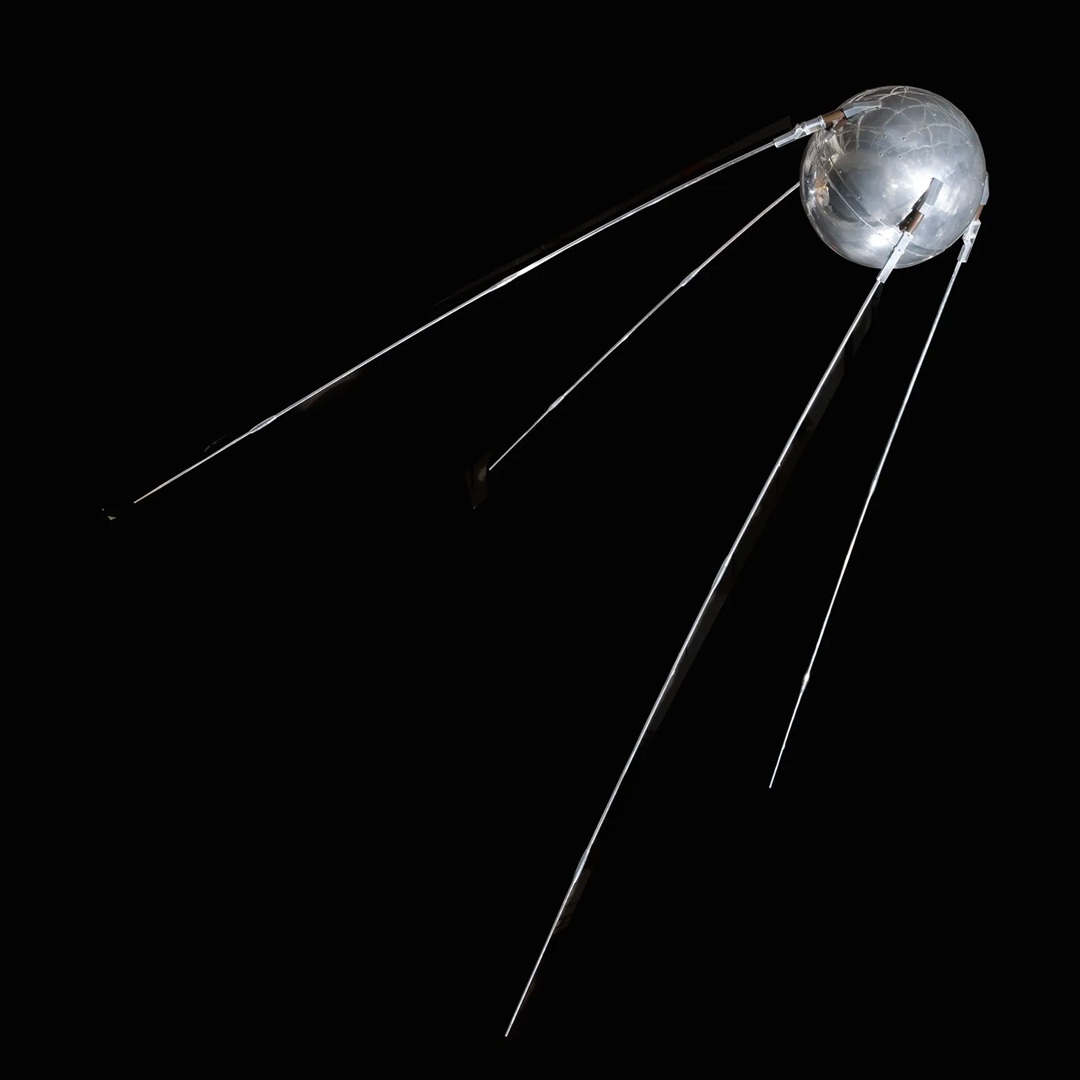
The Soviet Union launches Sputnik I, Earth’s first satellite
On Oct. 4, 1957, few Americans considered the reception at the Soviet Union’s Embassy in Washington, DC, to be anything out of the ordinary. It was the appropriate culmination of a week-long set of international scientific meetings. It was also, in the cynical Cold War world of international intrigue between the United States and the Soviet Union, an opportunity to gather national security intelligence and engage in petty games of one-upmanship between the rivals. This one would prove far different. The one-upmanship continued, but it was far from petty. To a remarkable degree, the Soviet announcement that evening changed the course of the Cold War.
Sputnik 1, launched on 4 October 1957 from the Soviet Union’s rocket testing facility in the desert near Tyuratam in the Kazakh Republic, proved a decidedly unspectacular satellite that probably should not have elicited the horrific reaction it wrought. An aluminum 22-inch sphere with four spring-loaded whip antennae trailing, it weighed only 183 pounds and traveled an elliptical orbit that took it around the Earth every 96 minutes. It carried a small radio beacon that beeped at regular intervals and could by means of telemetry verify exact locations on the earth’s surface. Some U.S. cold warriors suggested that this was a way for the Soviets to obtain targeting information for their ballistic missiles, but that does not seem to have actually been the case. The satellite itself fell from orbit three months after launch on 4 January 1958.
At the IGY reception the scientists immediately adjourned to the Soviet embassy’s rooftop to view the heavens. They were not able to see the satellite with the naked eye. Indeed, Sputnik 1 twice passed within easy detection range of the United States before anyone even knew of its existence. The next morning at the IGY conference, the Soviet Union’s chief delegate, Anatoli A. Blagonravov, explained details of the launch and the spacecraft. The CSAGI conference officially congratulated the Soviets for their scientific accomplishment. What was not said, but clearly thought by many Americans in both the scientific and political communities, however, was that the Soviet Union had staged a tremendous propaganda coup for the communist system, and that it could now legitimately claim leadership in a major technological field. The international image of the Soviet Union was greatly enhanced overnight.
Tags:
Source: National Aeronautics and Space Administration
Credit: Photo: A replica of Sputnik I at the Smithsonian National Air and Space Museum. Courtesy: Smithsonian Institution.