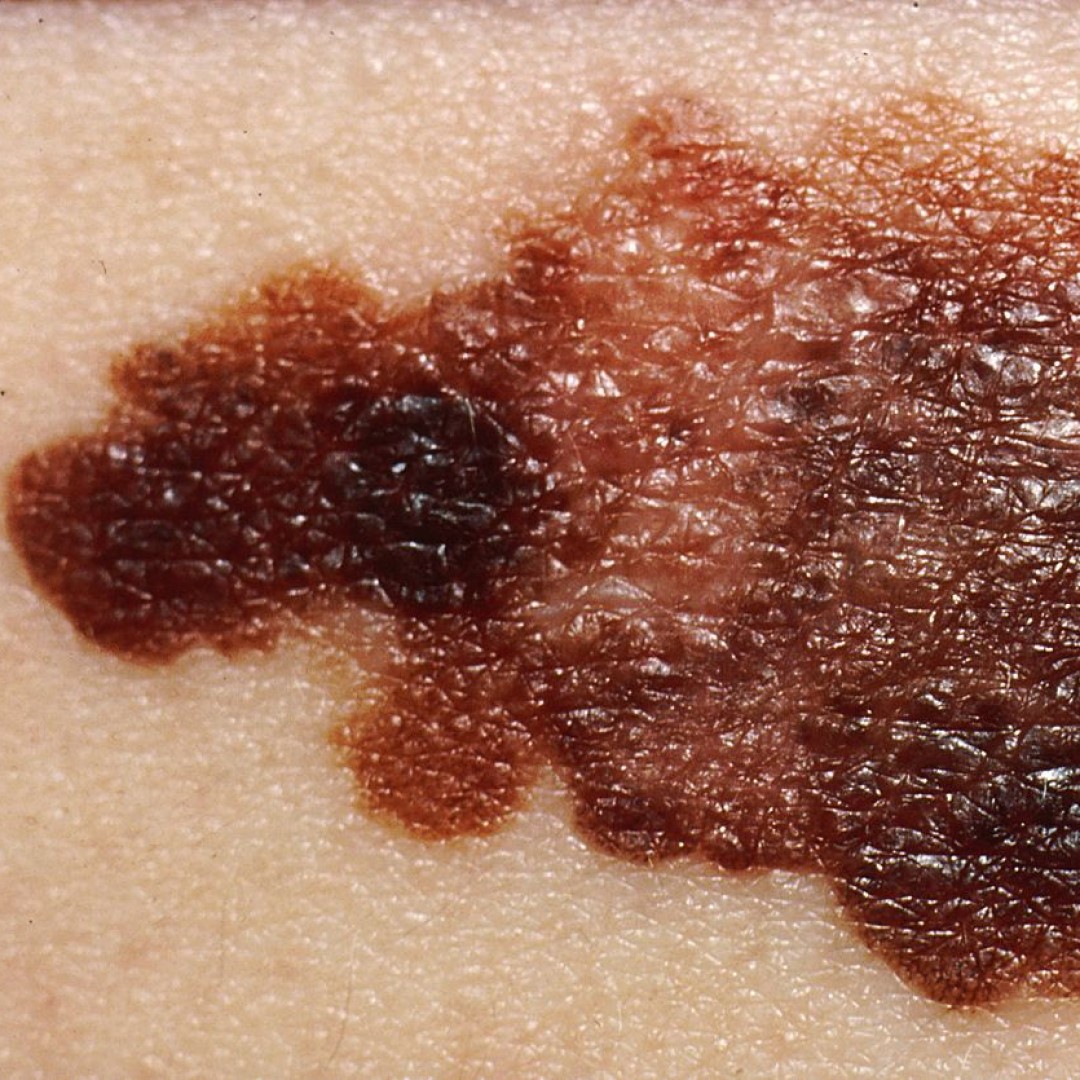
The National Cancer Institute scientists identified an inherited gene that strongly affects risk for the most common form of melanoma
On Jun. 29, 2006, researchers at the National Cancer Institute (NCI), part of the National Institutes of Health, have identified a link between inherited and acquired genetic factors that dramatically increase the chance of developing a very common type of melanoma. This finding appears in an online version of Science, and was a collaborative effort led by scientists at NCI and the University of California San Francisco. Also involved in the study were researchers at the University of Pennsylvania, Philadelphia, and Bufalini Hospital in Cesena, Italy.
People with fair skin are generally at increased risk of developing melanoma. Differences in skin color, or pigmentation, are due largely to the melanocortin-1 receptor (MC1R) gene. Everyone has two copies of MC1R; one inherited from the mother and one from the father, and either can be the standard form or a variant. Some variant forms of MC1R are responsible for traits such as fair skin, freckling, and red hair. But MC1R may do much more than influence pigmentation.
Melanomas, which are tumors that arise from cells which produce skin pigment, can occur on all parts of the body where these cells are present. Caucasians have a much higher chance than other populations of developing these tumors on skin areas that are exposed to the sun. Sun exposure has many effects on skin, including causing chronic sun damage, with wrinkling on areas subject to high exposure over a lifetime. Sun exposure may also lead to mutations in cancer-causing genes, such as BRAF, which are frequent in melanoma.
Because melanomas on skin areas with few signs of chronic sun-induced damage occur in younger people and exhibit frequent mutations in BRAF, the researchers hypothesized that there were inherited genetic factor(s) that predispose to the development of these melanomas with BRAF mutations. An interesting candidate for this genetic risk factor was the MC1R gene.
By categorizing patients into two groups, those with no variant forms of MC1R versus those who had at least one variant, the scientists found that BRAF mutations were six to 13 times more frequent in those with at least one MC1R variant form. Looking more closely, the investigators found that the risk for melanoma with BRAF mutations rose with increasing number of MC1R variant forms. Comparing data from melanoma patients and healthy controls, the risk for melanomas with BRAF mutations increased from seven times for individuals with one MC1R variant form, to 17 times for those with two variant forms, when compared with individuals with the standard MC1R.
The study results show that normal variations in the MC1R gene in Caucasians have a very specific effect on melanoma susceptibility. Additional inherited factors that affect susceptibility may also be present, but they have yet to be discovered.
Clinical trials for melanoma using pharmaceutical drugs directed against the BRAF gene are ongoing. Knowledge of predisposing factors in the development of BRAF mutations, such as MC1R, might aid prevention and therapeutic strategies in the future.
Tags:
Source: LiveJournal
Credit: