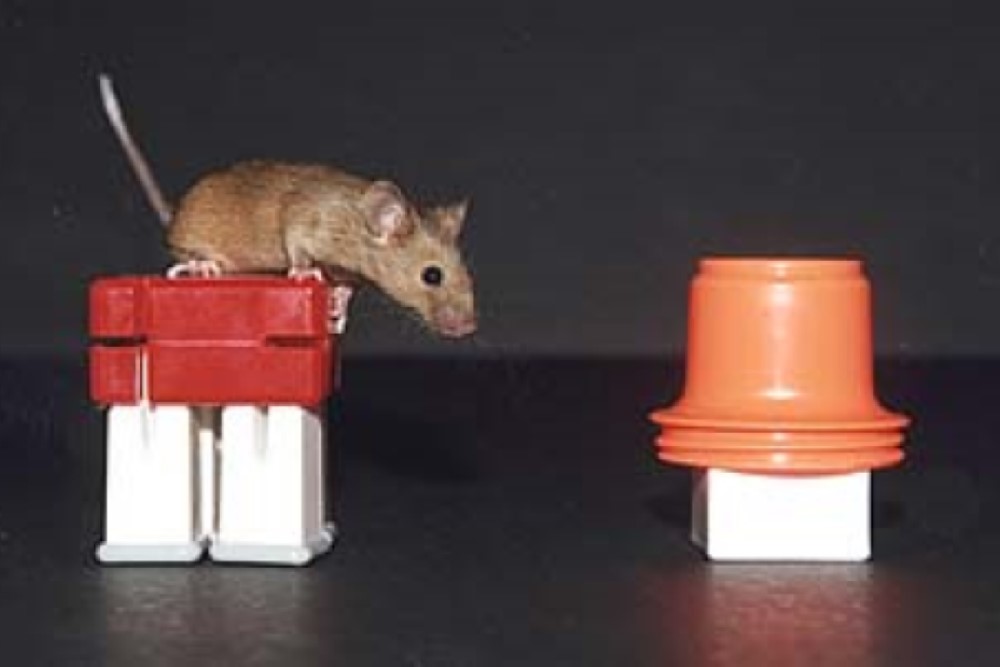
Scientists Create Smart Mouse
On Sept. 1, 1999, Princeton University researchers reported that they had genetically modified mice to have improved learning and memory.
Neurobiologist Joe Tsien, with collaborators at MIT and Washington University, found that adding a single gene to mice significantly boosted the animals’ ability to solve maze tasks, learn from objects and sounds in their environment and to retain that knowledge. This strain of mice, named Doogie, also retained into adulthood certain brain features of juvenile mice, which, like young humans, are widely believed to be better than adults at grasping large amounts of new information.
The work, reported in the September 2 issue of Nature, is a breakthrough in memory research and reveals a common biochemical mechanism at the root of nearly all learning. It shows that the brain uses the same basic tool when it forms associations, even though parts of the brain work in specialized ways and deal with diverse types of information, such as sights, sounds and touch. The result gives scientists confirmation of a long-standing theory about how we learn and remember, an idea posed in 1949 by Donald O. Hebb that had been central to memory research.
The finding also shows that genetic improvement of intelligence and memory in mammals is now feasible, thus offering a striking example of how genetic technology may affect mankind and society in the next century.
Taken together, these results could be of major interest to researchers trying to understand and treat human disorders that involve the loss of learning and memory. In particular, the NR2B gene could be a target for drug makers, who could try to design medicines that boost its effects. In the long-term, the results may promote further discussions on ethical and social issues regarding whether and how genetic technology should be used to modify or enhance mental and cognitive attributes in people. At this point, it has been shown that the corresponding gene exists in humans, but its enhancing effect in humans is not known.
Tags:
Source: Princeton University
Credit: