Scientists Create First-Ever ‘Smell Map’
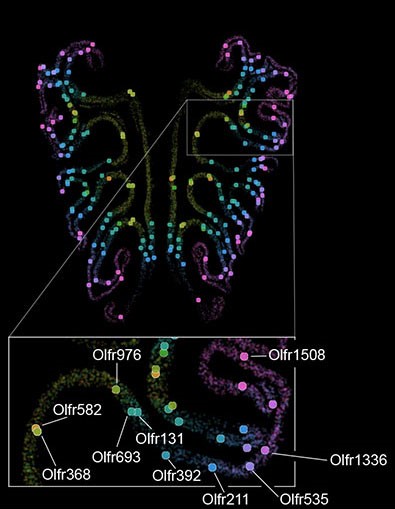
On Apr. 28, 2026, scientists Sandeep (Robert) Datta, professor of neurobiology in the Blavatnik Institute at Harvard Medical School and his team, working in mice, have now created the first detailed map of how the thousand-plus types of smell receptors in the nose are organized. They discovered that unlike what scientists had long believed, the neurons expressing these receptors have a high degree of spatial organization: They form horizontal stripes based on receptor type from the top of the nose to the bottom.
“Our results bring order to a system that was previously thought to lack order, which changes conceptually how we think this works,” said Datta, senior author of the study. Moreover, the researchers established that the receptor map in the nose matches up with smell maps in the olfactory bulb of the brain, providing clues about how information moves from the nose to the brain.
Maps have long existed that describe how receptors in the eye, ear, and skin are organized to capture and interpret auditory, visual, and touch information — and scientists have figured how these maps correspond with those inside the brain. However, “olfaction has been the one exception; it’s the sense that has been missing a map for the longest time,” Datta said. This is in part because it is more complicated than the other senses. Mice, for example, have around 20 million olfactory neurons that express more than a thousand types of smell receptors, compared with only three main types of visual receptors for color vision. Each type of smell receptor detects a unique subset of odor molecules.
In their new study, the researchers combined single-cell sequencing and spatial transcriptomics techniques to examine around 5.5 million neurons in more than 300 individual mice. The first technique allowed them to identify which smell receptors were expressed by neurons in the nose, and the second let them determine the locations of those receptors.
They discovered that the neurons are organized into tight, overlapping, horizontal stripes from the top of the nose to the bottom based on the type of smell receptor they express. This highly organized receptor map was consistent across the mice and mirrored the organization of smell maps in the brain, just like researchers have observed in vision, hearing, and touch.
The researchers then investigated how the smell map in the nose forms and identified retinoic acid — a molecule that helps control gene activity — as a key driver. They found that a gradient of retinoic acid in the nose guided each neuron to express the correct type of smell receptor based on its spatial location. Adding or removing retinoic acid caused the receptor map to shift up or down.
Now, the researchers are exploring why the receptor stripes are in this specific order. The team is also studying smell receptors in human tissue to understand to what degree the smell map is consistent across species. Such understanding will inform efforts to develop treatments — such as stem cell therapies or brain-computer interfaces — for loss of smell and its consequences, which include an increased risk of depression. The findings were published April 28 in Cell.
Tags:
Source: Harvard University
Credit: