quantum sensor could map single protein structures and lead to breakthroughs in medicine
On Jul. 28, 2026, a research team from the Institute for Quantum Computing (IQC) at the University of Waterloo announced they have developed a new method that uses a single molecule as a quantum sensor. Quantum sensors use unique properties of quantum mechanics to make ultra-precise measurements that traditional sensors cannot achieve.
A new quantum sensing technique could enable measurements of single protein structures and other important molecules, with potential applications in drug discovery and structural biology.
This technique has never been demonstrated before and uses a class of molecules for this purpose for the first time. Precise imaging of single molecules helps researchers understand how single proteins and other biomolecules behave. It can help reveal more information about how diseases develop and the ways drugs interact to potentially design more effective treatment.
The sensors probe the spin, or local magnetic environment of atoms. Because each atom has a unique resonance frequency, if two are close together, they magnetically affect each other.
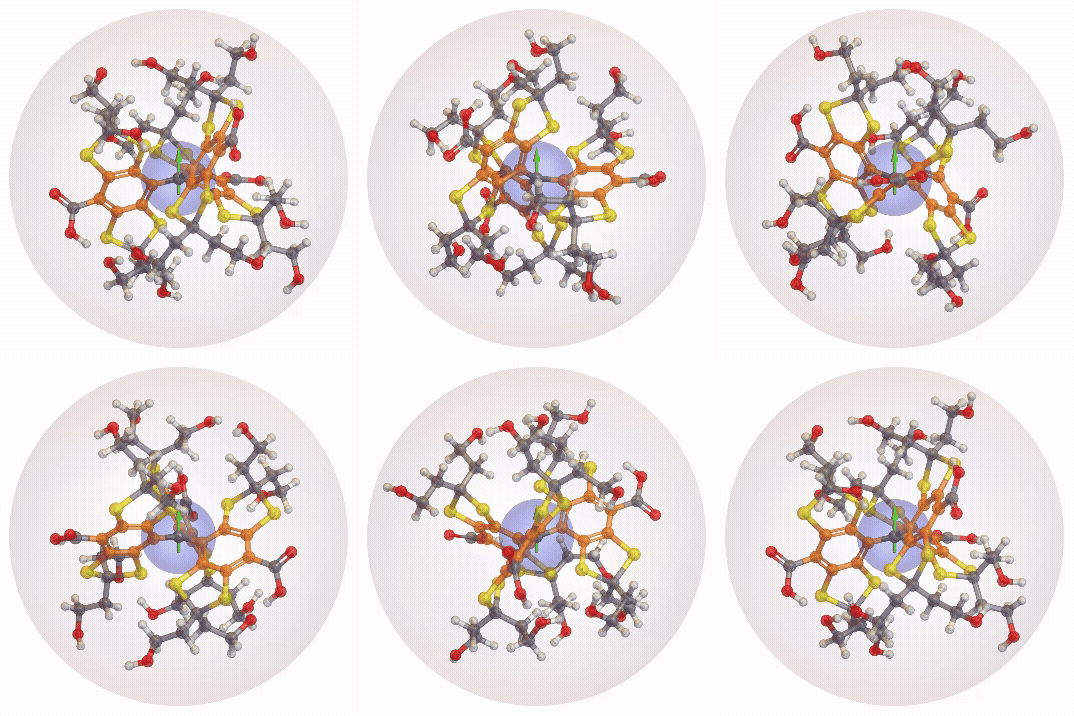
A well-established quantum-sensing technique uses synthetic diamonds designed with atomic-scale defects and involves light to read out signals. Budakian’s group used a class of molecules called trityl-OX063 as the quantum sensor. The spin of the sensor is isolated and protected, preserving its quantum properties. And, compared to the diamond sensing technique, it can be placed closer to the target it is sensing to achieve higher sensitivity.
Their method uses the electron spin of the OX063 molecule. The magnetic fields from nearby nuclear spins change the evolution of that electron spin. The resulting signal is detected mechanically using nanowire probes that are 100 nanometers in diameter, about the size of a virus, and 20 microns long, about the diameter of a human hair.
The paper Long-Lived Mechanically-Detected Molecular Spins for Quantum Sensing appears in Physical Review X.
Tags:
Source: University of Waterloo
Credit: Image: The researchers used a class of molecules called trityl-OX063 as the quantum sensor. Its spin is isolated and protected, preserving its quantum properties. Courtesy: University of Waterloo.