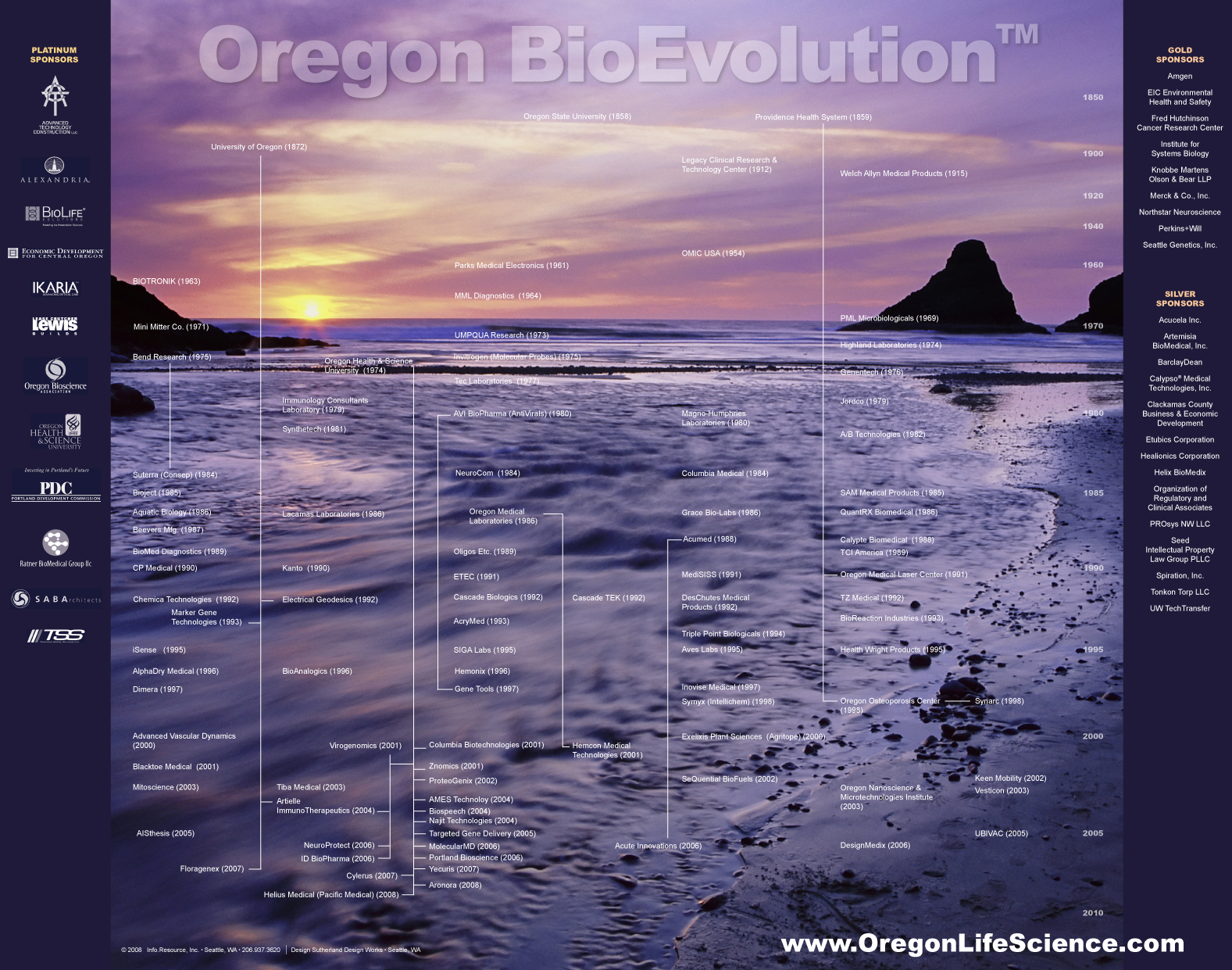
Oregon BioEvolution, 2008
On Jun. 1, 2008, Oregon BioEvolution was published illustrating life science companies and non-profit research organization in the State of Oregon by the year of their founding and the source of their ‘founding technology.’
Life Science Genealogy was first developed in 1990 by Phil Ness, LifeScienceHistory.com founder & CEO, with his creation of a biotechnology genealogy poster to communicate the depth, and breadth of the nascent industry to the Washington State Legislature. Of particular importance is how it’s interlinked with the state, and National Institutes of Health funded universities, federal labs, and non-profit research organizations across the nation.
In 1980, the Bayh-Dole Technology Transfer Act was passed by the U.S. Congress and is a landmark piece of legislation that significantly impacts technology transfer and innovation. It allows universities, and small businesses to own intellectual property (IP) developed with federal funding, incentivizing commercialization of discoveries and fostering economic growth.
In the state of Oregon, the life science industry is comprised of companies founded on technology developed commercially, along with those at state and federally funded non-profit research institutions, including: Oregon Health and Science University, the Earle A. Chiles Research Institute of Providence Cancer Center, Portland State University, University of Oregon, and Oregon State University.
Today, you can access our one-of-a-kind Life Science Genealogy on Demand, an evolving new feature, that displays more than 11,000 life companies and non-profit research organizations located in the United States and Canada. Companies are displayed by year established, location and ‘founding technology source’ whether ‘founded independently or founded on technology’ licensed from a university, federal lab or non-profit research organization. All displayed are also hyperlinked for additional information.
Tags:
Source:
Credit: