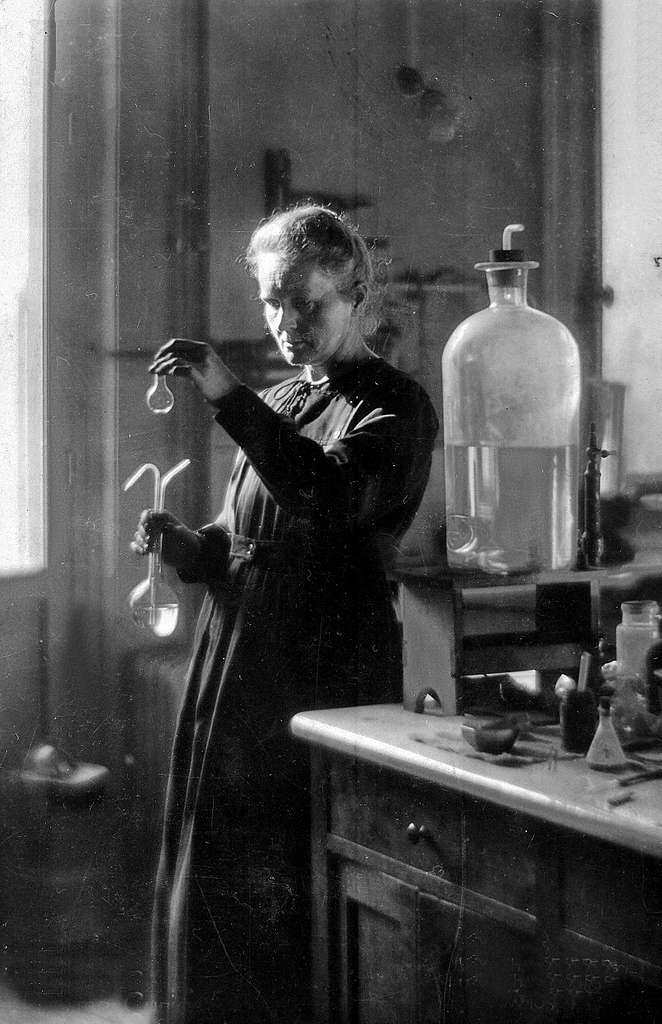
Marie Curie Sklodowska, won a share of the Nobel Prize in Physics “in recognition of the extraordinary services on the radiation phenomena”
In 1903, Marie Curie Sklodowska, shared the Nobel Prize in Physics along with her husband Pierre Curie and Antoine Henri Becquerel “in recognition of the extraordinary services they have rendered by their joint researches on the radiation phenomena discovered by Professor Becquerel.”
The 1896 discovery of radioactivity by Becquerel inspired Marie and Pierre Curie to further investigate this phenomenon. They examined many substances and minerals for signs of radioactivity. They found that the mineral pitchblende was more radioactive than uranium and concluded that it must contain other radioactive substances. From it they managed to extract two previously unknown elements, polonium and radium, both more radioactive than uranium.
Her early researches, together with her husband, were often performed under difficult conditions, laboratory arrangements were poor and both had to undertake much teaching to earn a livelihood. The Curies’ brilliant research and analyses led to the isolation of polonium, named after the country of Marie’s birth, and radium. Mme. Curie developed methods for the separation of radium from radioactive residues in sufficient quantities to allow for its characterization and the careful study of its properties, therapeutic properties in particular.
Throughout her life she actively promoted the use of radium to alleviate suffering and during World War I, assisted by her daughter, Irene, she personally devoted herself to this remedial work. She retained her enthusiasm for science throughout her life and did much to establish a radioactivity laboratory in her native city – in 1929 President Hoover of the United States presented her with a gift of $ 50,000, donated by American friends of science, to purchase radium for use in the laboratory in Warsaw.
Mme. Curie, quiet, dignified and unassuming, was held in high esteem and admiration by scientists throughout the world. She was a member of the Conseil du Physique Solvay from 1911 until her death and since 1922 she had been a member of the Committee of Intellectual Co-operation of the League of Nations. Her work is recorded in numerous papers in scientific journals and she is the author of Recherches sur les Substances Radioactives (1904), L’Isotopie et les Éléments Isotopes and the classic Traité’ de Radioactivité (1910).
Tags:
Source: The Nobel Foundation
Credit: