Harvard-led team Makes DNA on a Semiconductor Chip
On Jun. 17, 2026, Harvard researchers announced setting a new benchmark for enzymatic DNA synthesis by writing 64 distinct sequences in parallel on a semiconductor chip. Their device is limited by deprotection chemistry, rather than electronics — pointing to the next challenge of developing more localized, acid-driven chemistry to fully exploit the chip’s DNA-synthesis capabilities.
Silicon chips have powered computing for half a century. Increasingly, they are also becoming platforms to read and manipulate biology at scale – recording from many neurons, reading many DNA sequences, and now, synthesizing DNA.
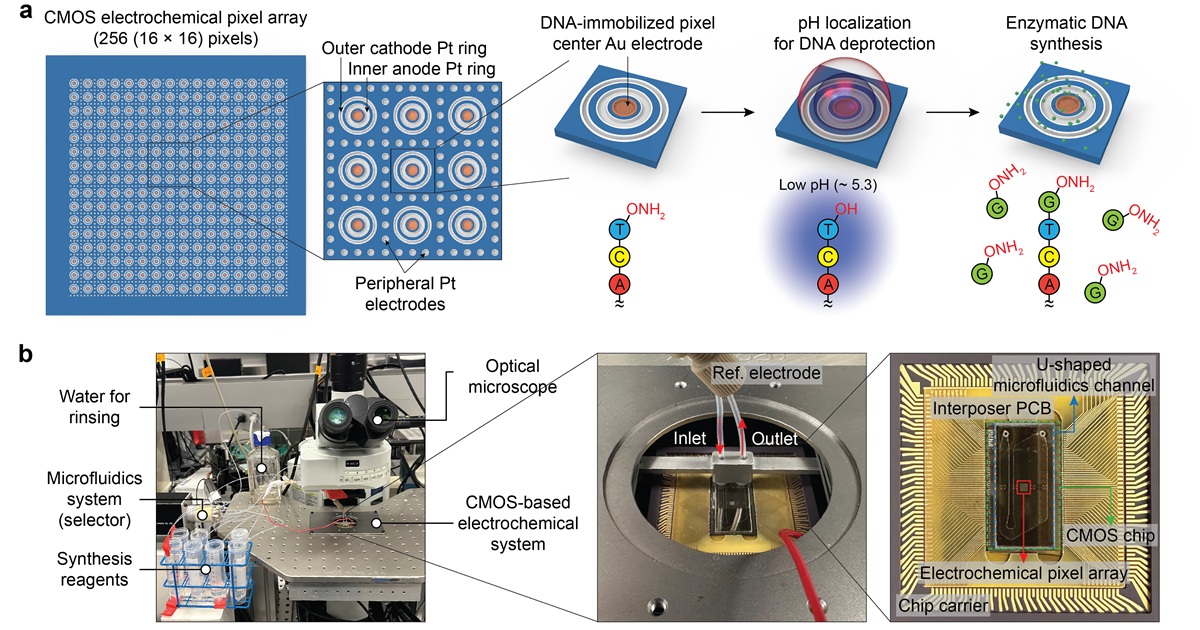
In a study published in Nature Electronics, a Harvard-led team reports a silicon chip that synthesized 64 distinct DNA sequences on its surface in parallel – not by using the solvent-heavy chemistry that dominates custom DNA manufacturing today, but through a water-based enzymatic process. The chip choreographs the parallel enzymatic synthesis, using finely controlled electric currents to trigger local reactions site by site. The research was led by Donhee Ham, the John A. and Elizabeth S. Armstrong Professor of Engineering and Applied Sciences at the John A. Paulson School of Engineering and Applied Sciences (SEAS).
Enzymatic DNA synthesis is emerging as a milder, water-based alternative, closer to how living cells build DNA, and could ultimately support smaller, safer and more accessible DNA-writing instruments. But it hasn’t come close to being able to produce the number of sequences in parallel that phosphoramidite chemistry can. To date, enzymatic synthesis has only been able to produce up to a dozen DNA sequences at a time. Against that backdrop, the Harvard team’s demonstration of synthesizing 64 distinct sequences in parallel, each up to 39 nucleotides long, sets a new benchmark.
Beyond nearer-term uses in synthetic biology and diagnostics, the team also used the 64 sequences to encode a 169-byte text, illustrating a longer-term possibility: DNA-based data storage. DNA data storage remains a more distant application because it would require DNA synthesis at enormous scale. But that scale is also what makes a water-based enzymatic route attractive: as the amount of DNA to be written grows, solvent use and environmental burden become increasingly important.
Tags:
Source: Harvard University
Credit: Image: A schematic of core steps in the enzymatic synthesis platform. Courtesy: Harvard University.