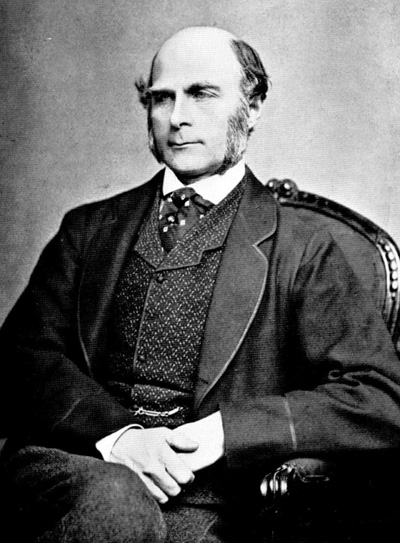
Francis Galton coined the term eugenics
On May 16, 1883, Francis Galton introduced the term eugenics that suggested humans can be improved by selective breeding. Galton detailed the concept in his book “Inquiries into Human Faculty and its Development.” The word “eugenics” was drawn from the Greek work “eu”, meaning well, and “genos”, meaning offspring.
Galton has earlier established himself at first as a geographer, explorer and meteorologist, rather than as a statistician or hereditarian. After his university career and the death of his father, Galton came into his fortune and spent some years living the life of a country gentleman, travelling around the British Isles hunting on the estates of friends, and travelling casually in Egypt and the Sudan.
By 1850 he seems to have tired of this, and made a crucial choice which launched his scientific career: he resolved to explore a little known region of Southern Africa, joining the Royal Geographical Society and receiving a mandate from them to launch and expedition.
Between April 1850 and January 1852 Galton explored and charted “Damaraland” and “Ovampoland” in South West Africa, financing the expedition himself. He was accompanied by Charles Andersson, an Anglo-Swedish amateur naturalist who would stay on in the region to seek his fortune. The original intention had been to penetrate from Damaraland to Lake Ngami, which had recently been described by Livingstone and promised an abundance of well-watered territory in the interior. Galton’s party was ultimately unable to reach the lake, and contented itself with charting the previously unknown interior regions of Ovampoland in northern South-West Africa, where they came close to the Cunene river but were ultimately forced to withdraw short of it.
The trip was remarkable for Galton’s acute ethnological observations of the inhabitants, and as he later put it: “I saw enough of savage races, to give me material to think about all the rest of my life” (Times, Dec. 1, 1886). Galton was also profoundly influenced by his study of the behaviour of the large herd of cattle the expedition depended on for food and transport; he would later combine these ethological and ethnological observations in his study of the evolution of variable and heritable traits.
Tags:
Source: Galton.org
Credit: