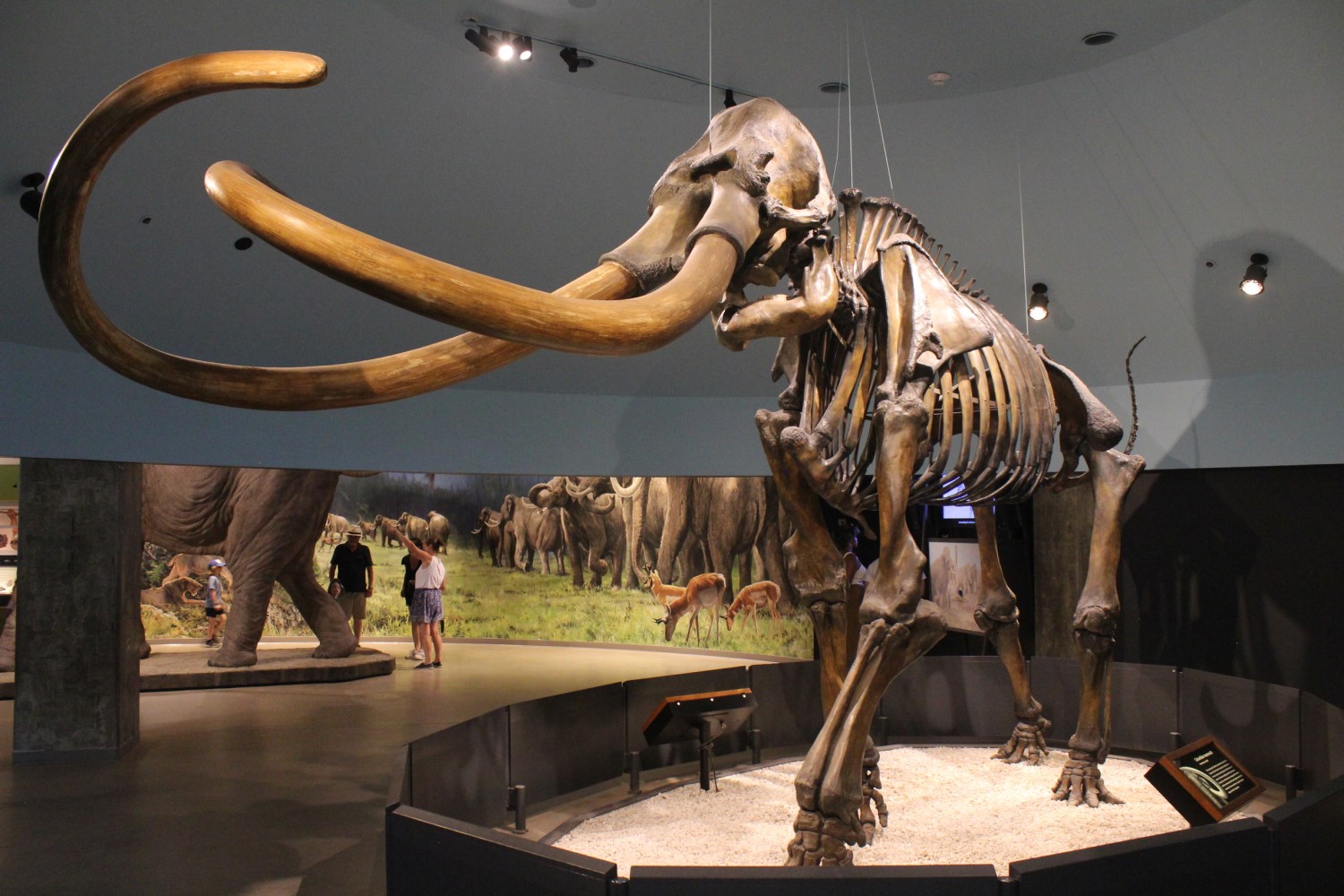
Fossils of ancient chromosomes discovered
On Jul. 11, 2024, a team led by scientists from Baylor College of Medicine, University of Copenhagen, and Centre Nacional d’Anàlisi Genòmica and Centre for Genomic Regulation reported discovering fossils of ancient chromosomes in the remains of a woolly mammoth that died 52,000 years ago. The fossils preserve the structure of the ancient chromosomes down to the nanometer scale – billionths of a meter. The discovery is featured on the cover of Cell.
Fossil chromosomes are a powerful new tool for studying the history of life on Earth. That’s because typical ancient DNA fragments are rarely longer than 100 base pairs, or 100 letters of the genetic code – far smaller than the full DNA sequence of an organism, which is often billions of letters long. By contrast, fossil chromosomes can span hundreds of millions of genetic letters.
“By comparing ancient DNA molecules to the DNA sequences of modern species, it’s possible to find cases where single letters of the genetic code have changed,” said co-first and co-corresponding author Dr. Olga Dudchenko, assistant professor of molecular and human genetics at the Center for Genome Architecture at Baylor College of Medicine and senior investigator at the Center for Theoretical Biological Physics at Rice University. “Fossil chromosomes are a game-changer, because knowing the shape of an organism’s chromosomes makes it possible to assemble the entire DNA sequence of extinct creatures. This enables the types of insights that would not have been possible before.”
Since the fossil chromosomes came from a mammoth, one of the first things the team did was to determine the number of chromosomes that the woolly mammoth possessed. “We found that they had 28 pairs of chromosomes, which makes a lot of sense, because that’s what modern elephants have, and they are the woolly mammoth’s closest living relative,” said Dr. Juan Antonio Rodríguez, co-first author of the study and a researcher at the University of Copenhagen and at Centre Nacional d’Anàlisi Genòmica in Barcelona, Spain. “It was extremely exciting to be able to count the chromosomes of an extinct creature for the first time. It’s usually not possible to have this much fun simply counting from one to 28.”
The idea that the mammoth remains, unearthed in 2018 in Siberian permafrost, were preserved in a glass-like state is not so farfetched. Without realizing it, many civilizations developed ways to induce a “glass transition” in their food as a way to preserve it, usually by a combination of cooling and dehydration. This resulted in foods, like tortilla chips and beef jerky – that are more brittle than the original food, but that last much longer. And it is why the glass transition has become a key concept for modern food scientists. Essentially, the researchers discovered that the chromosome fossils had been trapped inside a piece of freeze-dried woolly mammoth jerky.
Tags:
Source: Baylor College of Medicine
Credit: Photo: Skeleton of Mammuthus columbi, Courtesy Page Museum, La Brea Tar Pits.