Colossal Biosciences Is Working to Bring Back the Bluebuck, an Antelope Hunted to Extinction in 1800
On Apr. 30, 2026, Colossal Biosciences, the world’s de-extinction company, announced that it is working to de-extinct the bluebuck, a species of South African antelope that was hunted to extinction by European colonists around 1800 — making it the first antelope and the first African megafauna added to the company’s active de-extinction portfolio. The announcement adds the bluebuck to a roster that already includes the woolly mammoth, dire wolf, thylacine, dodo, and moa.
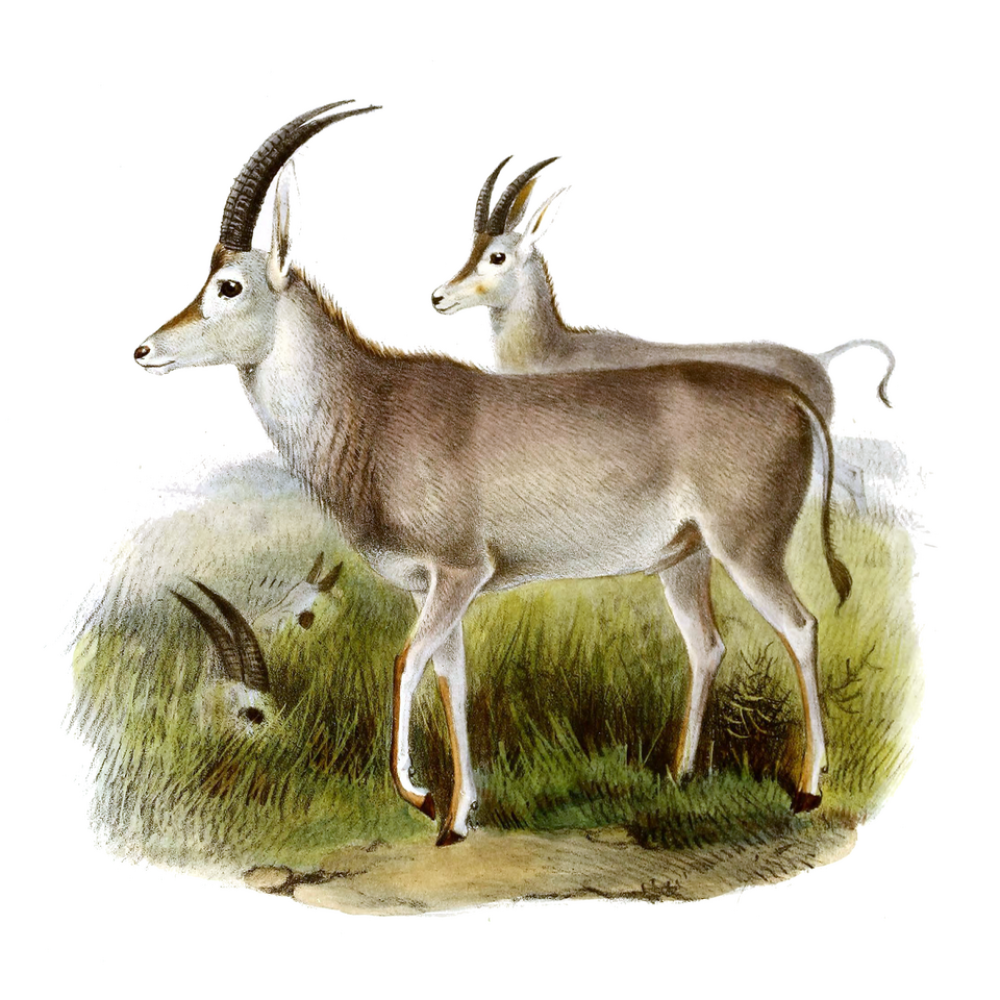
The bluebuck (Hippotragus leucophaeus) was a trim antelope native to South Africa, standing roughly 4 feet tall at the shoulder and stretching 10 feet from nose to rump. Its defining feature was a singular gray-blue coat — irresistible to European colonists who arrived in South Africa around 1650. Within approximately 150 years, hunting pressure drove the species to extinction. The last confirmed bluebuck was killed around 1800. Today the animal survives only in naturalist drawings and museum specimens, including a tissue sample now held at the Swedish Museum of Natural History.
The bluebuck project addresses a documented conservation crisis across antelope species globally. Of the 90 antelope species in the world, 55 are experiencing declining populations and 29 are currently threatened with extinction, according to Colossal. The bluebuck’s de-extinction is designed not only to resurrect a lost species but to build genetic tools transferable to living endangered antelope populations.
Colossal Biosciences will use the roan antelope — a close surviving relative of the bluebuck that ranges across sub-Saharan Africa — as both the genetic reference species and the surrogate. Researchers began by sequencing a bluebuck genome from a tissue specimen borrowed from the Swedish Museum of Natural History, using 40-fold coverage: sequencing each base pair 40 times to ensure accuracy. Comparing that sequence to the roan’s genome revealed that the two species differ by approximately 3% of their overall genome — but that 3% represents 18 million sequence variants.
Not all 18 million variants are relevant to the bluebuck’s defining physical traits. Colossal genome engineer Scott Barish explains the filtering process: “We filtered them and got to about three million variants. Then we got it down to 2.4 million truly functional regions of the genome, and then narrowed our focus to what are truly key phenotypes and got down to about 20,000. It’s so much more manageable but still an imposing number.” The team’s goal is to further distill that list to the small set of edits that express the bluebuck’s characteristic blue-gray coat, body size, and other defining traits — similar to the 20 edits on 14 genes used to convert a gray wolf genome into a dire wolf.
Once the key edits are identified, researchers will rewrite the DNA in a roan cell, extract the modified nucleus, and implant it into an enucleated roan egg. That egg will be allowed to develop into an embryo, then implanted into a roan surrogate for a 278-day gestation period — after which, if the process succeeds, a roan mother will give birth to a bluebuck calf.
Colossal Biosciences is partnering with the nonprofit Advanced Conservation Strategies to navigate regulatory and habitat requirements for potential bluebuck reintroduction. Unlike the three dire wolves — which live in a secured 2,000-acre private enclosure — the long-term goal for bluebucks is wild release in suitable southern African habitat, with herds large enough to be genetically self-sustaining. Whether that habitat will include the species’ original South African range is not yet determined.
Tags:
Source: Colossal Biosciences
Credit: