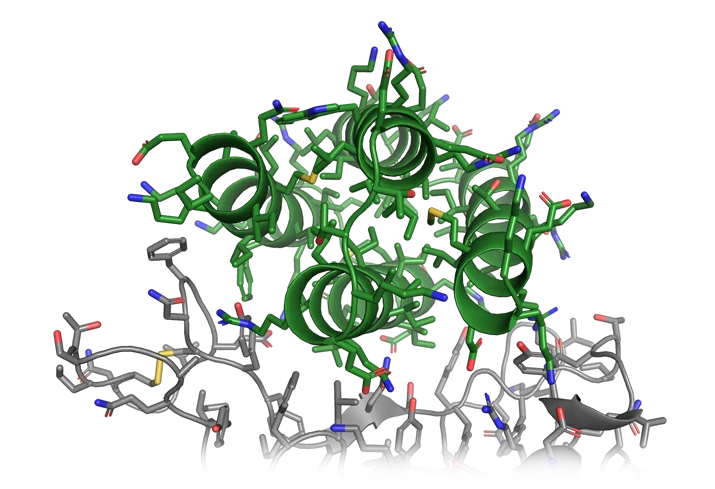
Citizen scientists helped researchers design new drugs to combat COVID-19
On Mar. 30, 2020, Howard Hughes Medical Institute Investigator David Baker created new proteins tailor-made for specific tasks. The University of Washington team began hunting for proteins that might stop the novel coronavirus ( SARS-CoV-2) from infecting human cells – and they enlisted citizen scientists to help via a free computer game called Foldit.
Foldit players around the world compete to solve protein puzzles digitally, designing molecules with certain specs. Scientists are now challenging players to design proteins that can glom onto the new coronavirus and block its entry into cells. Such proteins could potentially be developed into antiviral drugs, to lessen the severity of patients’ symptoms.
Protein building blocks called amino acids string together to form long chains. Those chains crumple into more compact 3-D structures – a protein’s finished shape. Researchers can predict how a chain might crumple, or work backwards to figure out what amino acid combinations create a particular protein structure.
Baker’s team has a good idea of what kind of protein they’re after. Like other coronaviruses, the virus that causes COVID-19 can infect cells via its “spike protein.” This protein latches onto certain human cells, letting the virus pass through the external membrane to multiply inside. A protein that grabs the coronavirus’s spike protein might be able to run interference, Baker says, preventing the virus from binding to cells.
Finding such a protein is a daunting task, he says. “There’s just this massive number of possibilities.” Cells build proteins from a toolkit of twenty standard amino acids. Any one protein can have hundreds of amino acids linked together, yielding billions of configurations.
Baker’s lab uses custom-made computer algorithms to speed the protein design process. Given a target shape, their program sends back amino acid combinations that, when folded, might yield something similar. The algorithms can also calculate the hypothetical proteins’ stability, which reflects how likely they are to hold their proposed shape in real life. The Foldit game works alongside this computer program, but lets humans take the reins. Players can build a protein from the ground up and tweak it as they go, trying to meet design criteria while competing for the highest stability score.
His team has had success using a similar strategy to design flu virus inhibitors. “In general, the coronaviruses appear to mutate less than influenza viruses,” Baker says. “So that makes them a little bit easier of a target.” Still, he cautions, his lab’s contribution is just the first step in a long journey toward a drug. They’ll send proteins that pass their screening test to other colleagues, who will test them on cells grown in culture dishes, and perhaps eventually in lab animals and humans.
Tags:
Source: Howard Hughes Medical Institute
Credit: Credit: Foldit/David Baker Lab