CDC Reports 4,811 Patients Admitted to Hospitals with Influenza, Cases Continue to Rise
On Oct. 23, 2026, the U.S. Disease Control and Prevention (CDC) reports that 4,811 patients were admitted to hospitals with influenza in the past week.
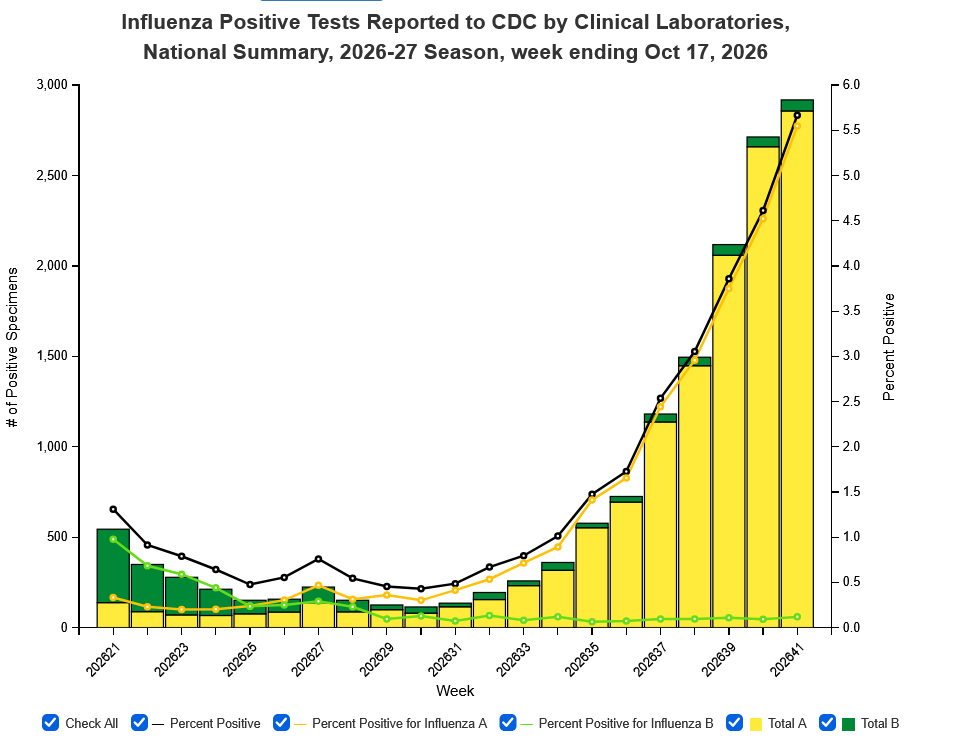
Seasonal influenza activity remains low nationally but multiple surveillance indicators, including the percent of specimens testing positive for influenza, outpatient visits for influenza-like illness (ILI), emergency department (ED) visits with an influenza discharge diagnosis, and laboratory confirmed influenza associated hospitalizations have been increasing since late August/early September, 2026.
One confirmed case of avian influenza A(H5N1) virus infection was reported to CDC this week. To date, human-to-human transmission of avian influenza A(H5) virus (H5 bird flu) has not been identified in the United States.
During Week 41 (the week ending October 17, 2026), of the 323 influenza viruses reported by public health laboratories, 318 were influenza A and 5 were influenza B. Of the 241 influenza A viruses subtyped during Week 41, 239 (99.2%) were influenza A(H1N1)pdm09, 2 (0.8%) were A(H5), and none were A(H3N2).
- Since Week 21 (the week ending May 30, 2026), 81.5% of the influenza A viruses reported have been A(H1N1)pdm09 and among these, the majority have been D.3.1.1 HA subclade.
- The A(H1N1) viruses detected this season are still A(H1N1)pdm09 viruses, which emerged in 2009 and have caused seasonal epidemics globally since then. Influenza viruses are constantly changing, usually requiring updates to influenza vaccine viruses each season. Historically, influenza A(H1N1)pdm09 viruses have changed less often than A(H3N2) viruses. Recently circulating influenza A(H1N1)pdm09 viruses (which are in an HA subclade called “D.3.1.1”) are dividing into different groups showing different genetic changes. It is too early to know what viruses may predominate or to say whether there might be implications on flu vaccine effectiveness this season.
Annual seasonal influenza (flu) vaccination is recommended. Influenza vaccines are available for persons aged 6 months and older. For most people, influenza vaccination should ideally be offered during September or October. Influenza vaccination during July and August is not recommended for most groups because of potential waning of immunity over the course of the influenza season.
Tags:
Source: U.S. Centers for Disease Control and Prevention
Credit: