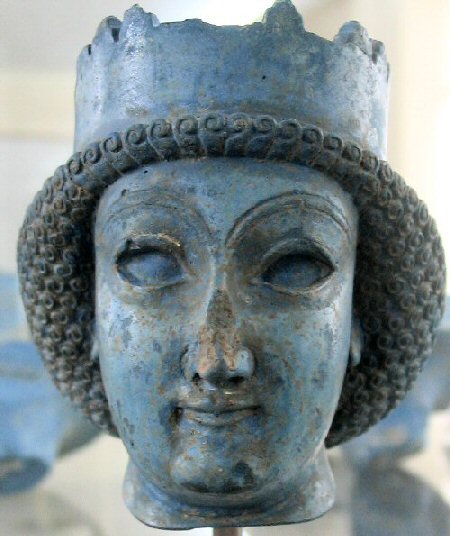
Atossa, daughter of Cyrius the Great: the first women diagnosed with breast cancer
In 470, Atossa, daughter of Cyrius the Great, became the first women in recorded history to be diagnosed with breast cancer. Greek historian Herodotus wrote that Atossa developed a painful growth or boil on her breast that eventually burst and began to spread. Out of shame, she initially hid the condition. Atossa was the wife of three kings-her brother Cambyses, the pseudo-Smerdis, and Darius Hystaspes-and was the mother of King Xerxes.
Not long after the accession of Darius in 521 B.C. he dislocated his ankle as he leaped from his horse during the chase. His Court physicians, who were Egyptians, were unable to reduce the injury and indeed made conditions worse by their violent treatment so that for a week the king was unable to sleep. A Greek physician, Democedes, had been the slave of Oroetes (a governor of Sardis appointed by Cyrus). Democedes was a friend of Polycrates, and was enslaved by Oroetes at this time. Some time later Darius had Oroetes killed for his several misdoings, so that Democedes came into the king’s possession. He was called in to treat the injured ankle.
Democedes was one of the most famous physicians of the sixth century B.C., and practised first in Aegina and Athens, then at the Court of Polycrates in Samos. His interests seem to have inclined to surgery rather than to medicine. He treated Darius by Greek methods, replacing the violent manipulations of the Egyptians by milder remedies. At first he enabled Darius to sleep and shortly afterwards was able to restore completely the function of the ankle. Democedes was suitably and liberally rewarded and held in high regard but his liberty was not restored.
Soon after this (according to the translation of Rawlinson) Atossa had a boil form on her breast which, after it burst, began to spread and increase. Now so long as the sore was of no great size, she hid it through shame and made no mention of it to any one: but when it became worse, she sent at last for Democedes and showed it to him.
The salient features of Atossa’s illness are that a swelling appeared in the breast, burst, continued to spread and increase until successfully treated by Democedes with the simple remedies available at that time (sixth century B.C.). We may be sure that no major surgery was undertaken and that cure probably resulted from simple non-operative measures. After her cure Atossa lived a normal life, bore four sons to arius and died at an advanced age.
Tags:
Source: Cambridge University
Credit: Photo: Bust of Atossa at the National Museum of Iran. Courtesy: Wikipedia.