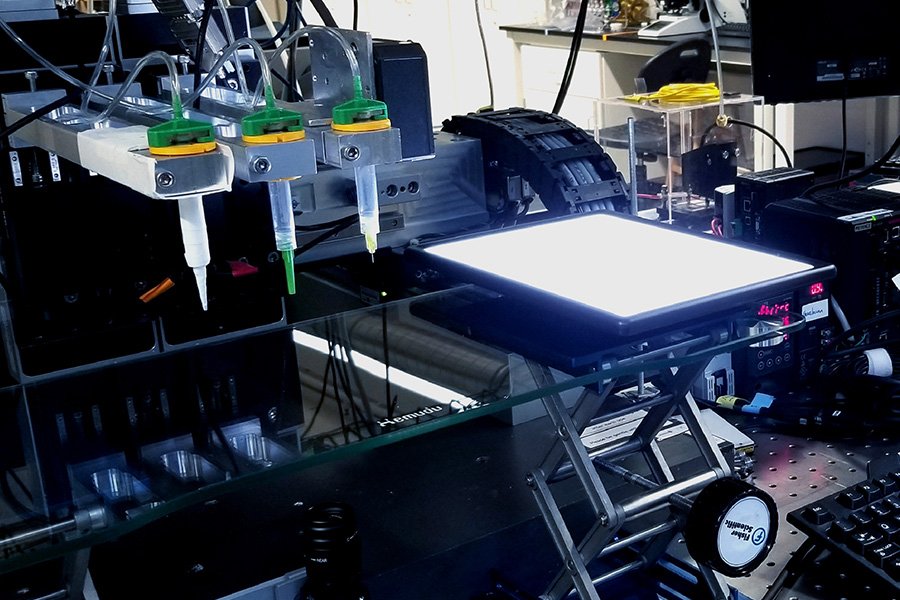
Adaptive 3D printing system to pick and place bugs and other organisms
On Aug. 21, 2024, researchers at the University of Minnesota (UM) announced a first-of-its-kind adaptive 3D printing system that can identify the positions of randomly distributed organisms and safely move them to specific locations for assembly. This autonomous technology will save researchers time and money in bioimaging, cybernetics, cryopreservation, and devices that integrate living organisms.
The research was published in Advanced Science, a peer-reviewed scientific journal. The researchers have a patent pending on the technology.
The system can track, collect, and accurately position bugs and other organisms, whether they are stationary, in droplets, or in motion. The pick-and-place method guided by real-time visual and spatial data adapts and can ensure precise placement of the organisms.
Typically, this process has been done manually and takes extensive training, which can lead to inconsistencies in organism-based applications. With this new type of system, the amount of time decreases for researchers and allows for more consistent outcomes.
This technology could increase the number of organisms processed for cryopreservation, sort live organisms from deceased ones, place organisms on curved surfaces, and integrate organisms with materials and devices in customizable shapes. It also could lay the groundwork for creating complex arrangements of organisms, such as superorganism hierarchies—organized structures found in insect colonies like ants and bees. In addition, the research could lead to advances in autonomous biomanufacturing by making it possible to evaluate and assemble organisms.
For example, this system was used to improve cryopreservation methods for zebrafish embryos, which was previously done through manual manipulation. With this new technology, the researchers were able to show that the process could be completed 12 times faster compared to the manual process. Another example showcases how its adaptive strategy tracked, picked up and placed randomly moving beetles, and integrated them with functional devices.
In the future, the researchers hope to continue to advance this technology and combine it with robotics to make it portable for field research. This could allow researchers to collect organisms or samples in areas that would normally be inaccessible.
Tags:
Source: University of Minnesota
Credit: Image: Adaptive 3D printing system, courtesy McAlpine Research Group, University of Minnesota.