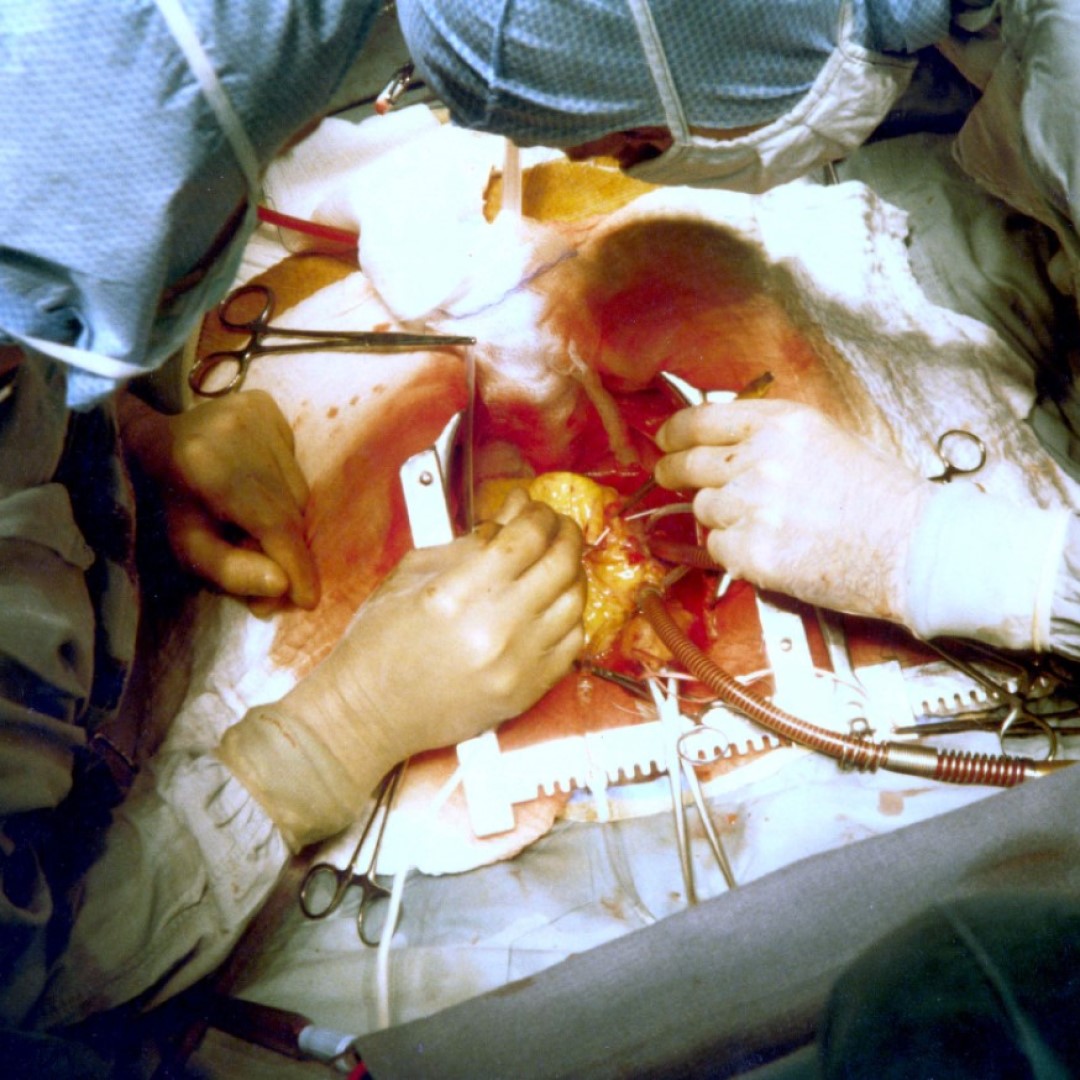
Drs. Lillehei and Lewis at the University of Minnesota performed the world’s first successful open-heart operation
On Sept. 2, 1952, Dr. C. Walton Lillehei professor of surgery at the University of Minnesota, participtade in the world’s first successful open-heart operation. Dr. C. Walton Lillehei is now known as the “Father of Open-Heart Surgery.”
The University made a world-renowned impact in cardiac surgery by performing the world’s first open-heart surgery using cross-circulation. These were the first open-heart surgeries in the world where they had direct visualization to stop the heart, pull the blood out, see the defect and then make the surgical repair. Dr. Lillehei and his team used cross-circulation, a procedure where one individual provided oxygenated blood to the other person who was undergoing open-heart surgery. This method, at the time, was an innovative way to keep the cardiac patient’s brain and vital organs working while doctors stopped blood flow to the heart for the repair. In most cases, the surgery was performed on a child with the parent supporting the oxygenated blood.
These procedures were established in 1954 and were used in some cases for patients who needed a large ventricular defect (VSD) repair. VSD is a defect in which someone is born with and is one of the most common congenital heart diseases; it’s a hole in the ventricle between the left and right side of the heart, which is an issue because the left ventricle is then pushing partially deoxygenated blood out to the rest of the body when it should be fully oxygenated. Without a procedure to fix the hole, the patient would eventually become very incompacitated and may even die.
Dr. Lillehei’s first successful cross-circulation patient in April 1954 was three years old, and his 25-year-old father provided him with the oxygenated blood needed during the procedure. His family, knowing the important history of the patient’s surgery, donated his body to the University’s Bequest Program and then to Visible Heart Laboratories for research and educational purposes.
Tags:
Source: Lillehei Heart Institute, University of Minnesota
Credit: