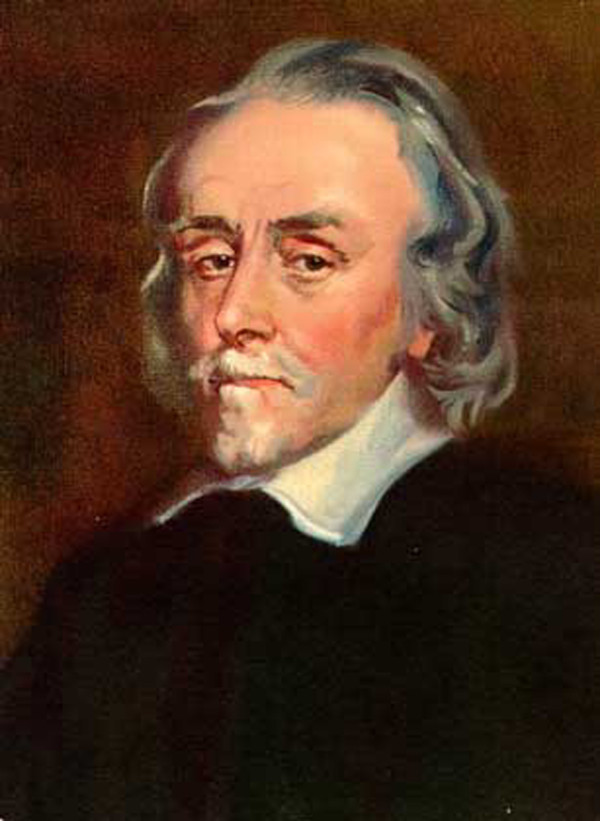
William Harvey described the circulatory system
In 1628, William Harvey, an English physician, published the “De Motu Cordis” (On the Motion of the Heart and Blood) in Frankfort-on-the-Main his completed treatise on the circulation of the blood.
Harvey received the degree of Medical Doctor from the University of Padua, Italy in 1602. After his return to England he became Fellow of the College of Physicians, physician to St. Bartholomew’s Hospital, and Lumleian lecturer at the College of Physicians. In 1618, Harvey was appointed physician extraordinary to James I, and he remained in close professional relations to the royal family.
Harvey focused much of his research on the mechanics of blood flow in the human body. Most physicians of the time felt that the lungs were responsible for moving the blood around throughout the body. Harvey’s famous “Exercitatio Anatomica de Motu Cordis et Sanguinis in Animalibus”, commonly referred to as “de Motu Cordis” was published in Latin at Frankfurt in 1628, when Harvey was 50 years old. The first English translation did not appear until two decades later.
Harvey, observing the notion of the heart in living animals, was able to see that systole was the active phase of the heart’s movement, pumping out the blood by its muscular contraction. Having perceived that the quantity of blood issuing from the heart in any given time was too much to be absorbed by the tissues, he was able to show that the valves in the veins permit the blood to flow only in the direction of the heart and to prove that the blood circulated around the body and returned to the heart. Fabricius, his teacher in Padua, had discovered the valves in the veins.
Direct observation of the heartbeat of living animals showed that the ventricles contracted together, dispelling Galen’s theory that blood was forced from one ventricle to the other. Dissection of the septum of the heart showed that it contained no gaps or perforations. When Harvey removed the beating heart from a living animal, it continued to beat, thus acting as a pump, not a sucking organ. Harvey also used mathematical data to prove that the blood was not being consumed. Finally, Harvey postulated the existence of small capillary anastomoses between arteries and veins, but these were not discovered until 1661 by Marcello Malpighi.
Tags:
Source: U.S. National Library of Medicine
Credit: