New insights on how bird flu crosses the species barrier
On Aug. 19, 2024, scientists at the European Molecular Biology Laboratory (EMBL) published research that sheds light on how a key avian influenza virus enzyme can mutate to allow the virus to replicate in mammals.
The Cusack group from EMBL Grenoble deciphered the structure of the avian influenza virus’s polymerase when it interacts with a human protein essential for the virus to replicate within the cell. The structure of this replication complex, published in Nature Communications, provides important information about the mutations that avian influenza polymerase must undergo to adapt to mammals, including humans.
Some avian influenza strains can cause severe disease and mortality. Fortunately, significant biological differences between birds and mammals normally prevent avian influenza from spreading from birds to other species. To infect mammals, the avian influenza virus must mutate to overcome two main barriers: the ability to enter the cell and to replicate within that cell. To cause an epidemic or pandemic, it must also acquire the ability to be transmitted between humans.
However, sporadic contamination of wild and domestic mammals by bird flu is becoming increasingly common. Of particular concern is the recent unexpected infection of dairy cows in the USA by an avian H5N1 strain, which risks becoming endemic in cattle. This might facilitate adaptation to humans, and indeed, a few cases of transmission to humans have been reported, so far resulting in only mild symptoms.
At the heart of this process is the polymerase, an enzyme that orchestrates the virus’s replication inside host cells. This flexible protein can rearrange itself according to the different functions it performs during infection. These include transcription – copying the viral RNA into messenger RNA to make viral proteins – and replication – making copies of the viral RNA to package into new viruses.
Viral replication is a complex process to study because it involves two viral polymerases and a host cell protein – ANP32. Together, these three proteins form the replication complex, a molecular machine that carries out replication. ANP32 is known as a ‘chaperone’, meaning that it acts as a stabiliser for certain cellular proteins. It can do this thanks to a key structure – its long acidic tail. In 2015, it was discovered that ANP32 is critical for influenza virus replication, but its function was not fully understood.
The results of the new study, published in the journal Nature Communications, show that ANP32 acts as a bridge between the two viral polymerases – called replicase and encapsidase. The names reflect the two distinct conformations taken up by the polymerases to perform two different functions – creating copies of the viral RNA (replicase) and packaging the copy inside a protective coating with ANP32’s help (encapsidase).
Tags:
Source: European Molecular Biology Laboratory
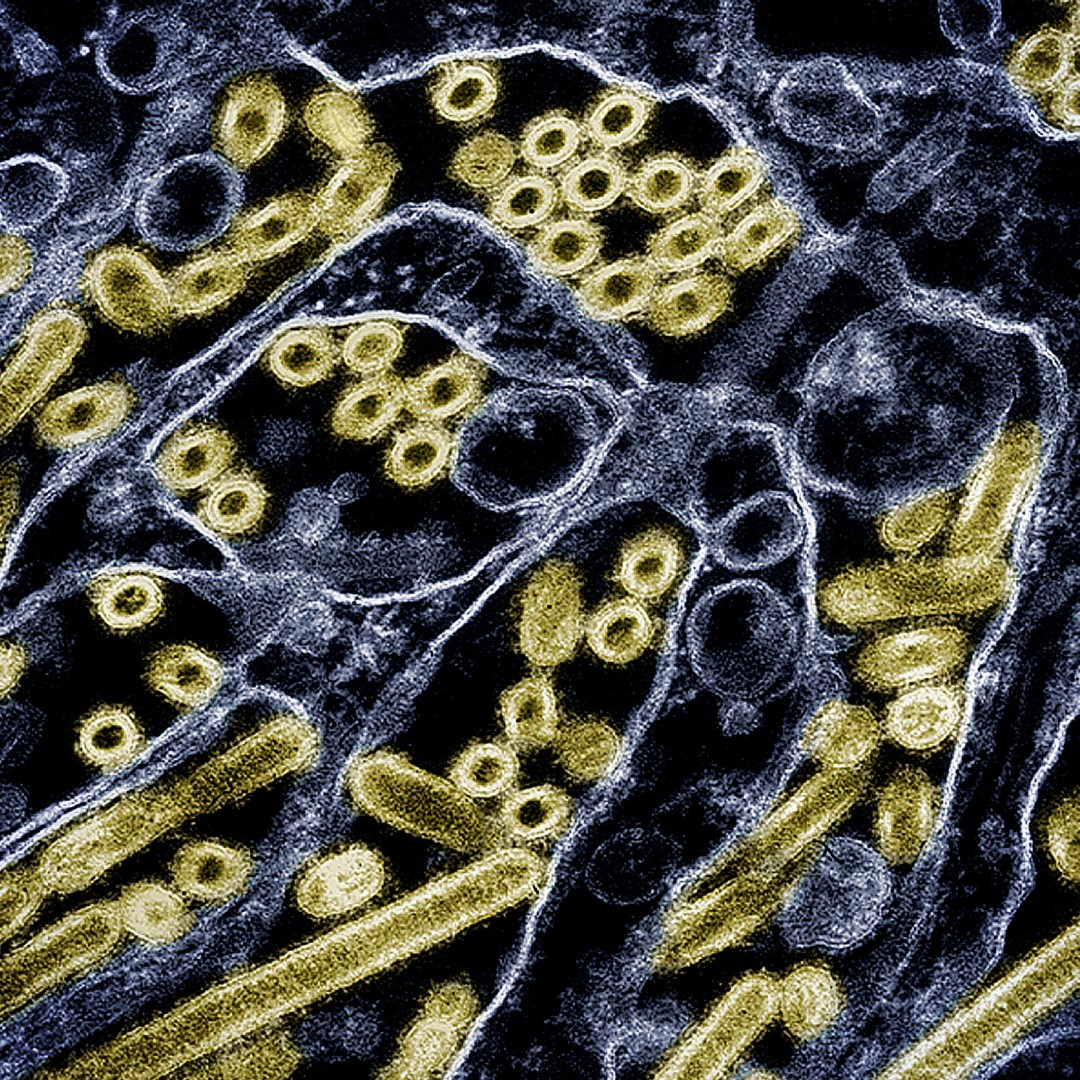
Credit: Colorized transmission electron micrograph of avian influenza A H5N1 virus particles (gold), courtesy National Institute of Allergy and Infectious Diseases and Centers for Disease Control and Prevention..