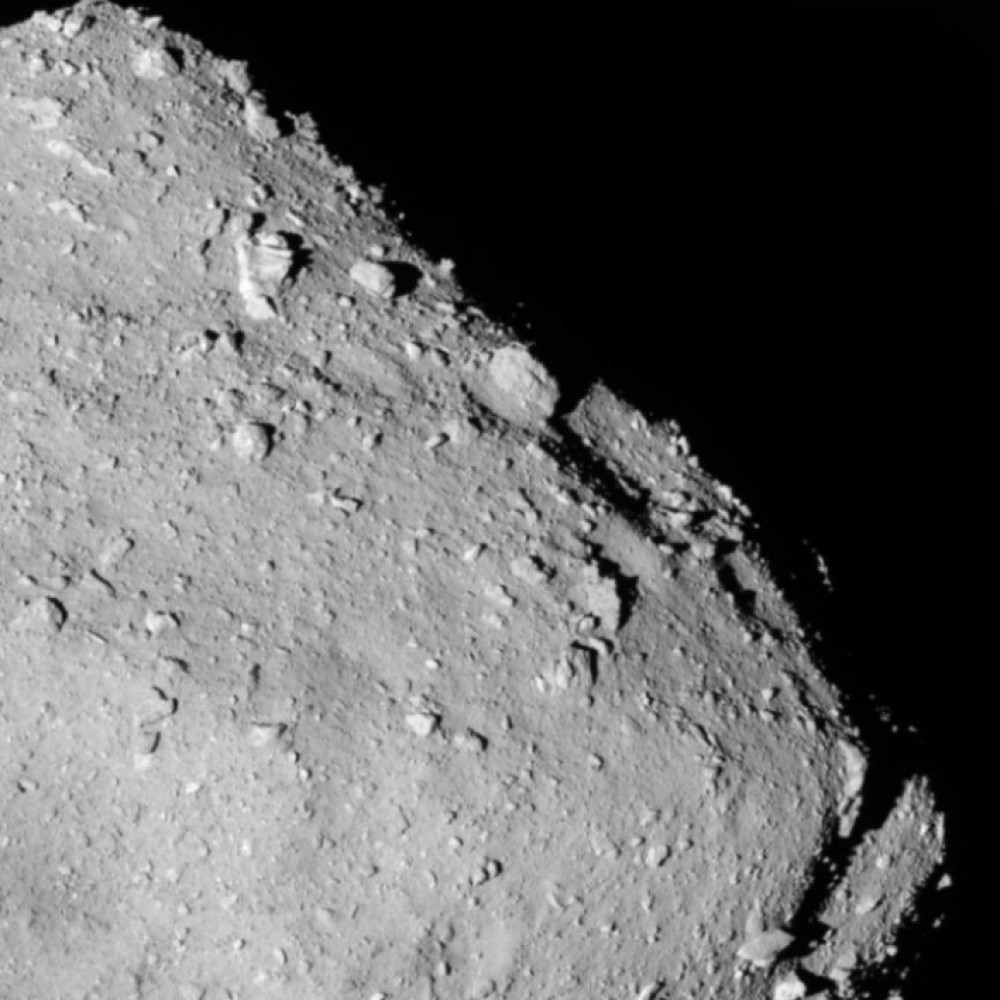
Astrobiologists Find All Five Nucleobases in Asteroid Ryugu
On Mar. 17, 2026, an international research team, including scientists from the Japan Agency for Marine-Earth Science and Technology announce finding all five nucleobases that make up DNA and RNA—purines (adenine and guanine) and pyrimidines (cytosine, thymine, and uracil)—have been conclusively identified in samples from asteroid Ryugu. The Hayabusa 2 brought 5.4 grams of sand from Ryugu to Earth in 2020.
An earlier analysis of Ryugu sand had detected only one type, called uracil, of the five primary building blocks of DNA and RNA, which record and transmit genetic information. But the team received a relatively large allocation of 20 milligrams of sand for the latest study, which confirmed the samples also contained the remaining four canonical nucleobases: adenine, guanine, cytosine and thymine.
The five nucleobases were also found in sand samples brought back in 2023 from the asteroid Bennu by the United States and other countries. This discovery supported the notion that substances essential for heredity are formed in space. The Japanese researchers compared their discovery with data on nucleobases found in a meteorite that fell in France in 1864. The results newly suggest that the proportions of the various nucleobases formed may have been influenced by the amount of ammonia present in the environment where the parent bodies of such asteroids and meteorites were situated.
The relative abundance of purine and pyrimidine nucleobases in Ryugu reflects their formation pathways. A clear correlation between the purine-to-pyrimidine ratio and ammonia abundance led us to propose a new molecular indicator of non-biological nucleobase evolution. The study was published in Nature Astronomy.
Tags:
Source: Japan Agency for Marine-Earth Science and Technology
Credit: Photo: Asaroid Ryugu, Courtesy: JAXA, University of Tokyo, Kochi University, Rikkyo University, Nagoya University, Chiba Institute of Technology, Meiji University, University of Aizu, AIST.