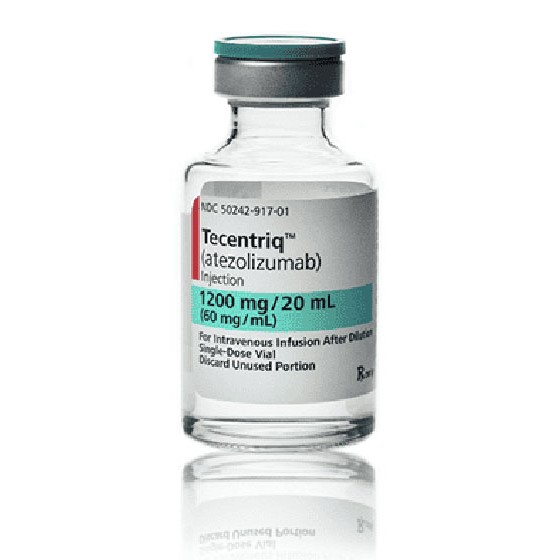
Genentech drug Tecentriq (atezolizumab) was approved
On Oct. 18, 2016, Genentech, a member of the Roche Group, announced that the U.S. Food and Drug Administration (FDA) had approved TECENTRIQ ® (atezolizumab) for the treatment of people with metastatic non-small cell lung cancer (NSCLC) who have disease progression during or following platinum-containing chemotherapy, and have progressed on an appropriate FDA-approved targeted therapy if their tumor has EGFR or ALK gene abnormalities. This approval is based on results from the randomized Phase III OAK and Phase II POPLAR studies. The largest study, OAK, showed that TECENTRIQ helped people in the overall study population live a median of 13.8 months, 4.2 months longer than those treated with docetaxel chemotherapy (median overall survival [OS]: 13.8 vs. 9.6 months; HR = 0.74, 95% CI: 0.63, 0.87). The study enrolled people regardless of their PD-L1 status and included both squamous and non-squamous disease types.
The TECENTRIQ development program includes more than 15 clinical trials in lung cancer, including seven Phase III studies in previously untreated (first-line) lung cancer. These studies are evaluating the use of TECENTRIQ alone or in combination with other medicines.
Possible serious side effects with TECENTRIQ include, but are not limited to, lung problems (pneumonitis), liver problems (hepatitis), intestinal problems (colitis), hormone gland problems (especially the pituitary, thyroid, adrenal glands and pancreas), nervous system problems (neuropathy, meningitis and encephalitis), eye problems (inflammation of the eyes), severe infections and severe infusion reactions.
OAK is a global, multicenter, open-label, randomized, controlled Phase III study that evaluated the efficacy and safety of TECENTRIQ compared with docetaxel in 1,225 people with locally advanced or metastatic NSCLC whose disease had progressed following previous treatment with platinum-containing chemotherapy, with the primary analysis consisting of the first 850 randomized patients. Patients with both squamous and non-squamous disease were randomized (1:1) to receive either TECENTRIQ administered intravenously at 1200 mg every 3 weeks or docetaxel administered intravenously at 75 mg/m 2 every 3 weeks. The co-primary endpoints were overall survival (OS) in all randomized patients (intention-to-treat [ITT] population) and in a PD-L1-selected subgroup in the primary analysis population.
The POPLAR study is a global, multicenter, open-label, randomized Phase II trial that evaluated the efficacy and safety of TECENTRIQ compared with chemotherapy (docetaxel) in people with previously treated recurrent locally advanced or metastatic NSCLC. The primary endpoint was OS; secondary endpoints included progression-free survival (PFS), objective response rate (ORR) and safety.
Tags:
Source: Genentech
Credit: