Largest Protein Yet Discovered Builds Algal Toxins
On Aug. 8, 2024, scientists at UC San Diego’s Scripps Institution of Oceanography announced they had discovered the largest protein yet identified in biology. Researchers found the protein, which they named PKZILLA-1, while studying how a type of algae called Prymnesium parvum makes its toxin, which is responsible for massive fish kills.
Published in Science and funded by the National Institutes of Health and the National Science Foundation, the study showed that this giant protein and another super-sized but not record-breaking protein – PKZILLA-2 – are key to producing prymnesin – the big, complex molecule that is the algae’s toxin.
Finding the genes that undergird the production of the prymnesin toxin could improve monitoring efforts for harmful algal blooms from this species by facilitating water testing that looks for the genes rather than the toxins themselves.
“Monitoring for the genes instead of the toxin could allow us to catch blooms before they start instead of only being able to identify them once the toxins are circulating,” said Timothy Fallon, a postdoctoral researcher in Moore’s lab at Scripps and co-first author of the paper.
Discovering the PKZILLA-1 and PKZILLA-2 proteins also lays bare the alga’s elaborate cellular assembly line for building the toxins, which have unique and complex chemical structures. This improved understanding of how these toxins are made could prove useful for scientists trying to synthesize new compounds for medical or industrial applications.
“Understanding how nature has evolved its chemical wizardry gives us as scientific practitioners the ability to apply those insights to creating useful products, whether it’s a new anti-cancer drug or a new fabric,” said Moore.
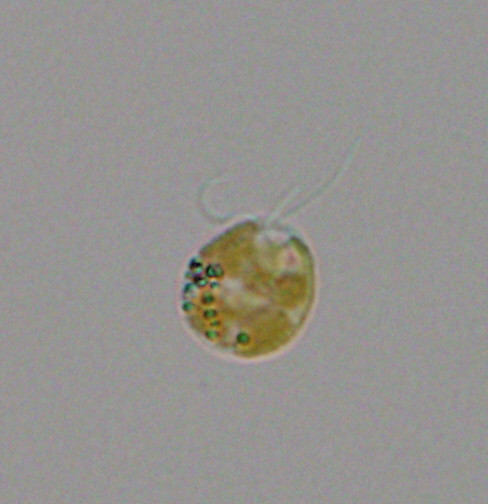
Prymnesium parvum, commonly known as golden algae, is an aquatic single-celled organism found all over the world in both fresh and saltwater. Blooms of golden algae are associated with fish die offs due to its toxin prymnesin, which damages the gills of fish and other water breathing animals. In 2022, a golden algae bloom killed 500-1,000 tons of fish in the Oder River adjoining Poland and Germany. The microorganism can cause havoc in aquaculture systems in places ranging from Texas to Scandinavia.
Tags:
Source: Scripps Institution of Oceanography
Credit: Image: A single cell of the toxin-producing golden alga (Prymnesium parvum), courtesy Greg Southard, Texas Parks and Wildlife Department.