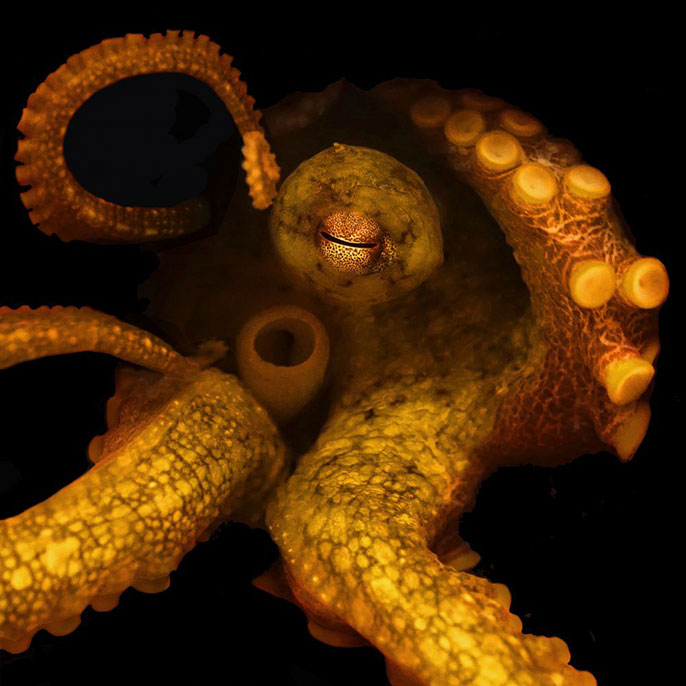
First-ever octopus genome sequenced
On Aug. 12, 2015, the Cephalopod Sequencing Consortium announced the first-ever sequencing of the entire octopus genome. Researchers discovered unusual features that shed light on octopus evolution and biology, and set the stage for future studies on complex nervous system development.
The work was conducted by teams from the University of Chicago, University of California Berkeley and the Okinawa Institute of Science and Technology as part of the Cephalopod Sequencing Consortium. Published in Nature, the research revealed striking differences between the genome of the octopus and other invertebrates.
Octopuses, along with squids and cuttlefish, are cephalopods, a class of marine invertebrates with an evolutionary history spanning more than 500 million years. They have some of the most sophisticated behaviors in the animal kingdom: large, highly-developed brains capable of learning and problem-solving (like opening a food-filled jar, for example). They also have a suite of unique physical traits: the ability to regenerate complex limbs, camera-like eyes-which make them excellent hunters-and a sophisticated camouflage system.
One of biggest surprises in the octopus genome was the expansion of two gene families, including the protocadherins, which regulate neuronal development. It was previously thought that only vertebrates possessed numerous and diverse protocadherins; they are crucial in setting up the wiring of the mammalian nervous system. The researchers found that protocadherins are 10 times more common in octopus genes than in mammals.
The other gene family, zinc-finger transcription factors, play a role in nervous system function and development. The octopus genome has 1,800 of these transcription factors–the second-largest gene family discovered so far in animals.
Tags:
Source: ECO
Credit: Image: Octopus by Albert Kok.