Researchers Report analysis of ancient Egyptian paint binders and adhesives Using Proteomics
On Aug. 26, 2026, an international team of researchers report analysis of ancient Egyptian paint binders and adhesives using mass spectrometry–based proteomics to confidently identify the species and tissues of origin of proteinaceous materials in painted ancient Egyptian artifacts from several collections dating 1425 BCE to 400 CE. Proteomics confirmed the use of glue prepared from the collagen of multiple animals and revealed the presence of plant proteins, including sesame and moringa products, previously undocumented in ancient Egyptian artworks.
A close examination of artifacts and an investigation of historical sources indicate that paint binders and adhesives used in ancient Egypt are mainly water soluble, with the exception of the attested use of beeswax in several Romano-Egyptian mummy portraits. The most common sources of these binders and adhesives are proteins (animal glue and egg) and polysaccharide-based (plant gum) materials. Often based on visual observations, animal glue was believed to be the most common proteinaceous artistic material used from a very early period in ancient Egypt. This material is made by boiling animal bones and connective tissues to retrieve collagen and other proteins.
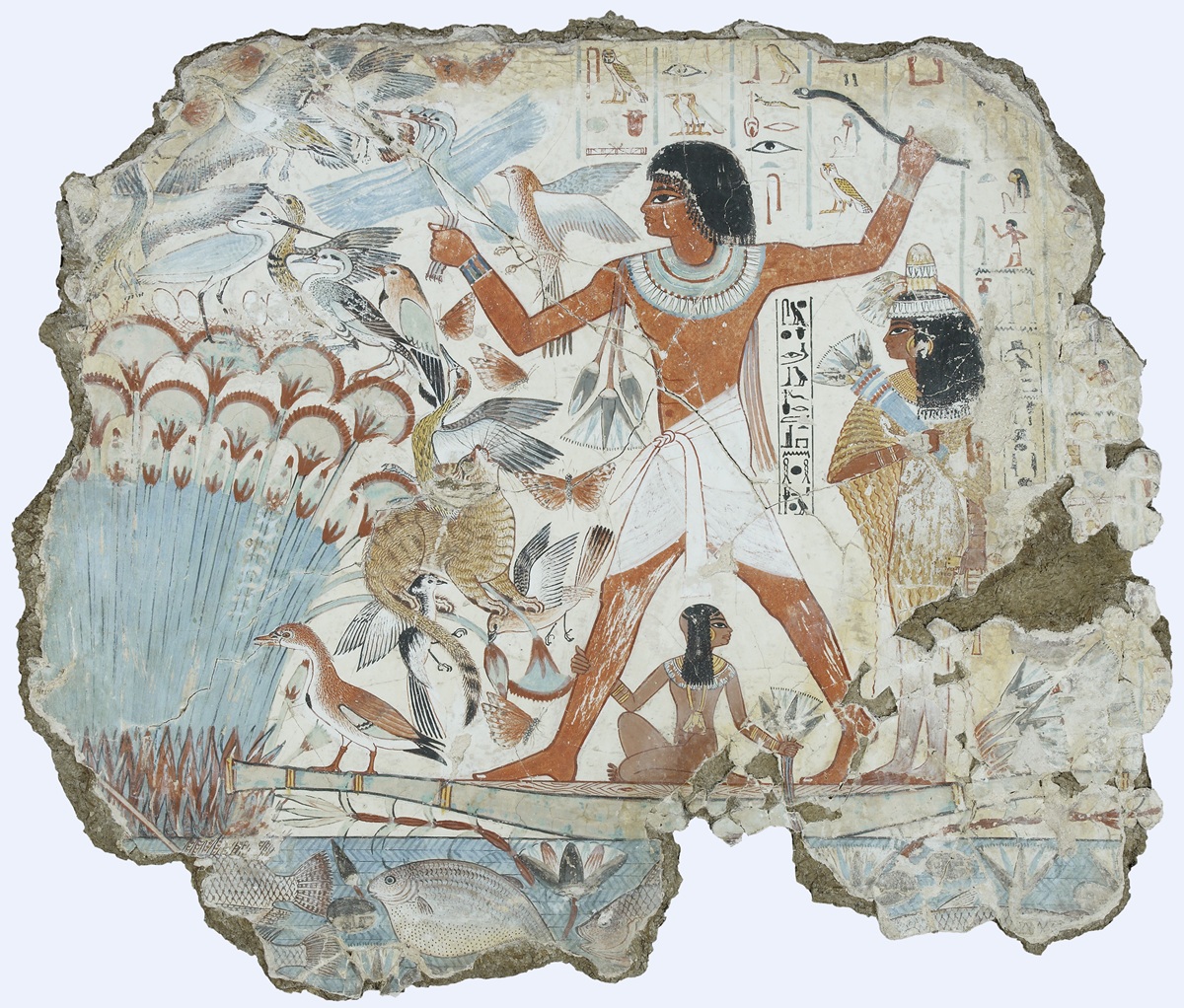
In total, 28 samples from 14 different painted artworks, dating 1425 BCE to 400 CE, from the Egyptian collections of the Medelhavsmuseet in Stockholm (Sweden), the British Museum in London (UK), and the Ny Carlsberg Glyptotek in Copenhagen (Denmark), were analyzed by shotgun proteomics using nano-flow liquid chromatography tandem mass spectrometry (nanoLC-MS/MS), following a first screening by FTIR analysis (see the Supplementary Materials). The set of selected artworks includes supports of various nature: wooden coffins (painted and with residues of the sealing adhesive), wall painting fragments from the tomb of Nebamun and Sobekhotep, painted plaster as applied in cartonnage construction as well as non-cartonnage objects, and painted limestone architectural elements.
Besides the detection of collagen proteins, paleoproteomic analysis provided the unexpected but confident identification of distinctive seed-storage proteins from sesame (S. indicum) and moringa (M. oleifera). Both plant genera were available in ancient Egypt at the time of the objects investigated in our study and the Supplementary Materials].
This study presents the first extensive paleoproteomics-based investigation of the biological origin of proteinaceous materials used as binders and adhesives in ancient Egypt. Until now, paleoproteomics has established cow (B. taurus) as the primary resource for glue preparation in paint samples from ancient Egyptian artifacts, and only recently, studies of Romano-Egyptian mummy masks have identified animal glue prepared from E. asinus and a mix of animals (cattle, hippo, warthog, and wild boar) as binder and adhesive for gilding, respectively.
Other plant proteins from cereals, primarily wheat, with the addition of proteins from barley and rye, were identified by proteomics in the paint layers from two different wall paintings (Table 2). Archaeological and archaeobotanical findings indicate that agriculture in Egypt was established around the 6th millennium BCE with emmer wheat (T. turgidum subsp. dicoccoides, a wild type of the domesticated T. turgidum subsp. durum) and hulled barley (H. vulgare) being the primary ingredients of two of the most important foods in the ancient Egyptian diet: bread and beer.
This prompts additional discussions about the origins of these materials, their symbolic and religious meaning in connection with deities, and their value within the artistic, cultural, and economic contexts of ancient Egypt. The study demonstrates that combining paleoproteomics results with other analytical methods, archaeological evidence, and textual sources sheds light on expected and more unconventional organic materials in painted artworks from ancient Egypt.
Tags:
Source: American Association for the Advancement of Science
Credit: