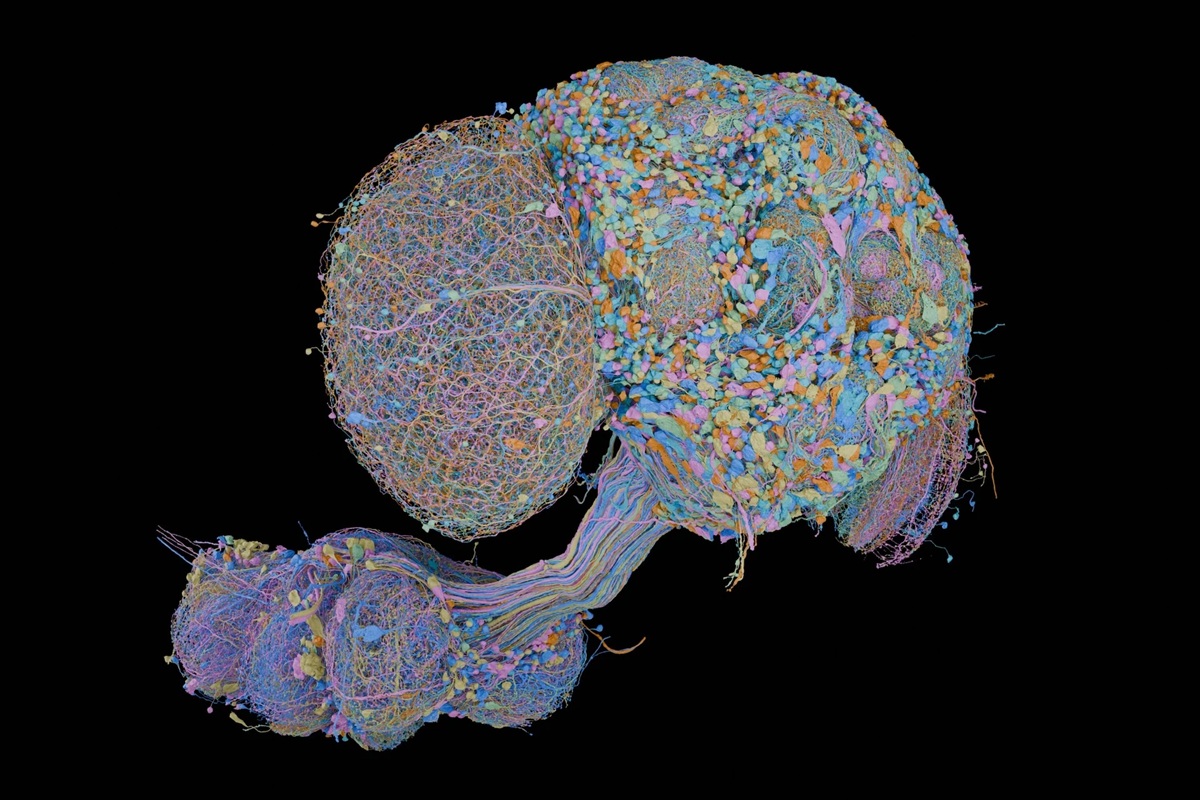
Scientists Complete Full Map of the Fruit Fly Central Nervous System
On Sept. 3, 2026, Janelia scientists and collaborators announced they have completed a wiring diagram of the central nervous system of an adult male fruit fly, the culmination of nearly two decades of groundbreaking research.
The road to the full connectome started with mapping small, biologically interesting parts of the brain. Then, in 2020, the researchers unveiled the hemibrain. With 25,000 neurons, the map of half of the fly brain was the biggest and most detailed connectome ever created, proving the feasibility and utility of a fly brain map. The hemibrain connectome enabled hundreds of research findings throughout the scientific community, revealing insights about how the brain works. It also made it easier for other scientific teams to enter the field, with research teams around the world now pursuing wiring diagrams of increasingly complex brains.
When researchers at HHMI’s Janelia Research Campus set out to create a map of all the neurons in the fruit fly brain in 2008, many in the scientific community thought they were out of their minds. It had been 20 years since scientists had unveiled the wiring diagram — or connectome — of the 302 neurons in the tiny worm C. elegans, an effort that took more than a decade. Most scientists thought mapping the fly brain, with more than 100,000 neurons, would take too long and cost too much — and they didn’t think it would tell neuroscientists much about how the brain worked. Today, that vision has come to fruition with the publication of the connectome of the full central nervous system of a fruit fly: a wiring diagram of more than 166,000 neurons that make up the fly’s brain and ventral nerve cord and the millions of connections between them.
The newly completed connectome is the first map of an entire male fruit fly central nervous system, comprising all the neurons in the brain, both optic lobes, and ventral nerve cord. It will allow scientists to trace the complete neuronal circuits that link sensory perception to behavior enabling researchers to determine how flies carry out key actions, like navigating to a goal. It is also allowing researchers to compare male and female brains and understand complex social behaviors — like mating and aggression — that can vary by sex.
In addition to providing a resource for the entire scientific community, Janelia researchers and collaborators have already started to uncover new biological insights about the differences between male and female fly brains, and the insect’s visual and taste systems.
Tags:
Source: Howard Hughes Medical Institute
Credit: Credit: Image by Philip Hubbard/HHMI Janelia Research Campus.