Largest Molecular Map of Autism Opens Path to Precision Therapies
On Aug. 27, 2026, researchers in the University of California San Francisco (UCSF) School of Pharmacy’s Quantitative Biosciences Institute (QBI) and the UCSF Department of Psychiatry and Behavioral Sciences have taken a major step toward answering both questions. Over more than a decade of work, the team developed the largest map of molecular interactions in autism, revealing how hundreds of genes and dozens of mutations converge within a small number of shared protein networks. The result could open new roads in developing precision medicines for the disorder.
Rather than focusing only on the genes linked to autism, the researchers mapped the proteins encoded by those genes. They discovered how individual disease-causing mutations can rewire the molecular machinery of the developing brain. The work uncovered a new layer of disease biology that could offer targets for future therapies. It also provides a framework for designing medicines that address a wide range of underlying molecular causes of autism.
The study is most directly relevant to individuals with profound autism, which makes up about 30% of diagnoses. Many of these individuals carry rare, high-impact mutations in established autism risk genes.
One of the study’s key findings is that many genetically distinct forms of autism disrupt the same dozen protein complexes. Instead of requiring different therapies for every mutation, these shared molecular hubs could be tapped to develop medicines capable of treating multiple genetic forms of autism.
Drugs designed to restore these shared protein interactions could potentially benefit many patients, while offering advantages in brain delivery, tolerability, scalability, and manufacturing. More broadly, the work establishes a general framework for connecting disease-causing genetic variations to protein networks, molecular mechanisms, and therapeutic targets, a strategy that may ultimately be applicable across many human diseases.
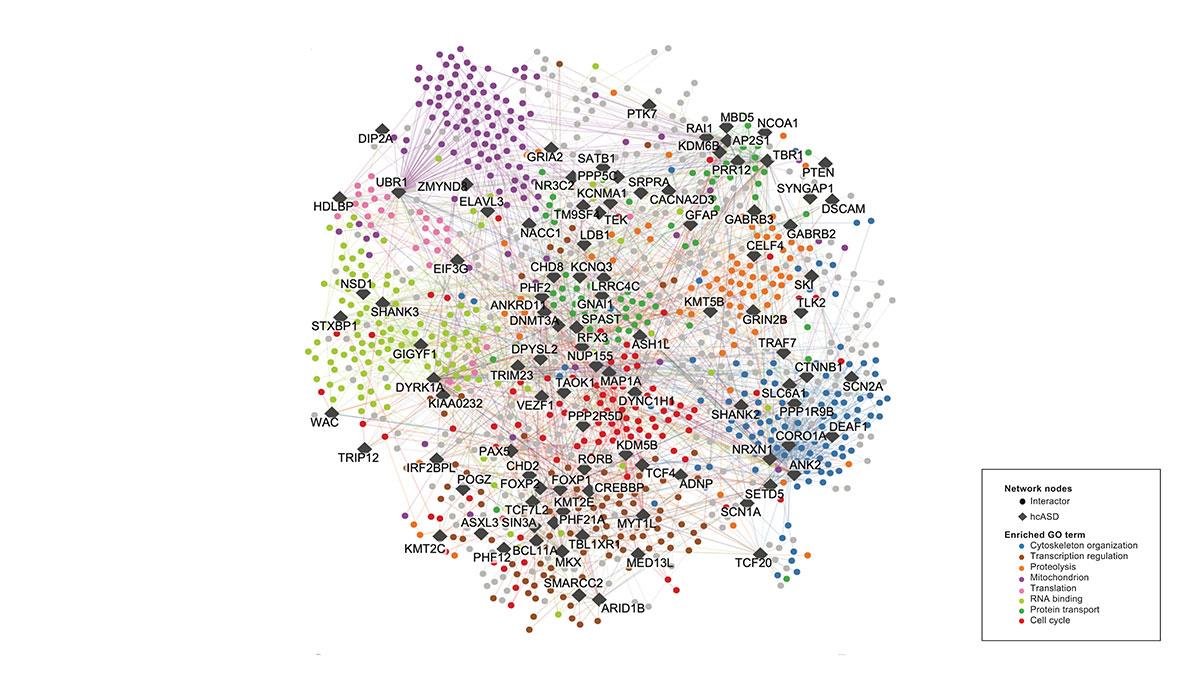
The study systematically mapped protein-protein interactions for 100 high-confidence autism risk genes using affinity purification-mass spectrometry (AP-MS). The map revealed more than 1,800 protein interactions, 87% of which had never been reported previously. The researchers then analyzed 54 patient-derived autism mutations, revealing how distinct genetic variants rewire protein interaction networks to produce convergent effects on brain development.
QBI laid the groundwork for the research during the COVID-19 pandemic in mapping the SARS-CoV-2 human protein interaction network. The project identified 69 drug candidates, 27 of which advanced into clinical trials. The current study also marks a milestone in a more than decade-long partnership between QBI and the Department of Psychiatry and Behavioral Sciences at UCSF, known as the Psychiatric Cell Map Initiative (PCM). This effort has identified the causal biology of a neuropsychiatric disorder at the molecular level, laid the foundation for a targeted therapeutic approach in autism spectrum disorder, and established a generalizable blueprint for moving from genetics to therapy that could inform how we approach other complex genetic diseases.
Tags:
Source: University of California San Francisco
Credit: Protein-protein interaction network for autism spectrum disorder spanning a 100 high risk autism proteins (diamonds) and over 1,000 interactions (dots). Courtesy: University of California San Francisco.