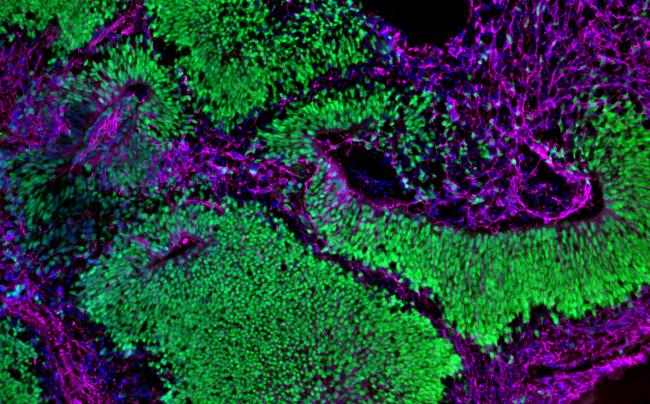
Lab-grown brain ‘organoids’ set longevity record
On Aug. 19, 2026, in a new milestone for stem cell research, Harvard neuroscientists have set a record for keeping alive lab-grown human brain “organoids” and proven that they mimic key developmental stages seen in living people.
In a paper published this week in Nature, the team reported that these peppercorn-sized clumps of brain cells — each containing more than 1 million cerebral cortex cells derived from human donors — were sustained in the lab for more than five years, three times longer than the previous record. These tiny “avatars” of human brains also retained memories of their own histories and could be manipulated to skip forward to more advanced stages of development — a feature that one day could be exploited to replace diseased cells, or to engineer lab-grown organs.
Organoids offer promising models for brain research, but progress has been limited by the difficulty of keeping delicate cells alive in a lab dish — especially neurons, the fundamental units of the nervous system. The previous record for the oldest organoid was 694 days and reported in 2021 by a team of researchers at UCLA and Stanford.
Human brains continue to develop and mature for two decades — an unusually long timeline compared to other species. But most previous studies involving organoids have managed to replicate only the early phases of that brain development.
It remained unknown how well lab-grown cells would model the development of brains over longer timescales and whether all cell types could survive. To shed light on these questions, Harvard researchers sought to extend the longevity of the cell cultures.
Organoids offer promising models for brain research, but progress has been limited by the difficulty of keeping delicate cells alive in a lab dish — especially neurons, the fundamental units of the nervous system. The previous record for the oldest organoid was 694 days and reported in 2021 by a team of researchers at UCLA and Stanford.
The lab now has some organoids that are seven years old. But maintaining these fragile cell cultures over many years is difficult and expensive, and there are no plans to continue for the sake of setting a new longevity record. Instead, the team seeks to target key phases by pursuing the “time warp” capability.
Tags:
Source: Harvard University
Credit: