Scientists Map Proteins From Billion-Year-Old Organism and Discover New Links to Rare Diseases
On May 27, 2026, a University of Texas at Austin-led team has identified genes by comparing groups of proteins found in a wide range of species, and by using animal models and human patient data, previously unknown to be connected to three rare disorders, a discovery that sheds new light on the genetic causes of human diseases.
The research team made the discovery by reconstructing the most detailed map to date of the molecular machines that carried out the functions of life in an ancient ancestor that gave rise to all complex life on Earth, including humans. This representation of protein networks, known as the protein interactome and published in Cell Genomics, is like a treasure map the researchers used to dig up hundreds of genes that were not previously known to be associated with human diseases.
The cells inside every living thing are like microscopic cities with molecular machines that make energy, transport supplies from place to place, build structures, and get rid of trash. Because these machines are so critical for the survival of an organism, versions of them have been passed down over more than a billion years of evolution. Molecular machines are made of proteins, which are produced with instructions stored in genes. And because these ancient molecular machines are so important for life, when one of the genes that helps build them breaks, it can lead to serious diseases in humans.The data analysis that made the discovery possible was enabled by the Texas Advanced Computing Center (TACC), a National Science Foundation-supported center based at UT that offers the most powerful academic supercomputing capabilities in the nation.
Problems with a faulty gene having ancient roots in the map could be tied to issues across the evolutionary tree of complex organisms, also known as eukaryotes. For example, a gene that can cause a form of deafness in humans can also cause plants to be unable to sense which way is up or down, disrupting normal growth.
Given this connection between genes, molecular machines and disease, the researchers were able to use their ancient ancestor-based protein interactome — essentially a map of protein networks — to identify previously unknown genes associated with disease.
Scientists speak about the 1.5 to 1.8 billion-year-old single-celled organism from which all complex life on the planet descended as the Last Eukaryotic Common Ancestor (LECA). The research team discovered that about half of human genes can be traced back to an earlier version in LECA, and versions of these same genes are shared broadly with organisms across the eukaryotic tree of life.
Using frog and mouse models, the team confirmed gene associations with three rare human disorders: osteopetrosis, end-stage kidney disease and short-rib thoracic dysplasia. In follow-up studies, the researchers plan to use animal models to experimentally verify whether specific genes revealed by the new map truly are associated with human diseases.
Tags:
Source: University of Texas at Austin
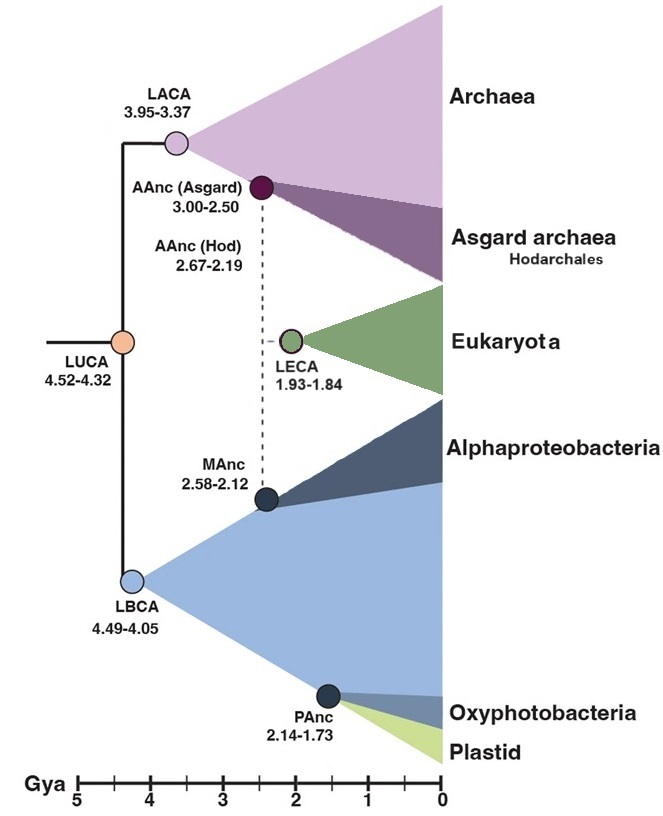
Credit: Illustration: Timing of cellular evolution across the tree of life based on a cross-braced dated ribosomal species tree and ATP synthase gene tree. Courtesy: Wikipedia.