Microrobots repair spinal cord
On Jun. 2, 2026, a research team from ETH Zurich and the University of Zurich (UZH) announced it has developed a novel approach to treating spinal cord injuries: controllable microrobots deliver stem cells directly to the site of an injury, where they promote nerve cell regeneration. In animal experiments, this approach significantly improved mobility.
Spinal cord injuries can have devastating consequences for those affected. Nerve cells in the spinal cord rarely regenerate naturally, while scarring often prevents the regrowth of nerve fibres. Modern therapies attempt to influence implanted stem cells using electrical stimulation to promote the growth of new nerve cells. This approach has several drawbacks: it requires implanted electrodes, and the transplanted cells do not always survive or integrate properly into the existing tissue.
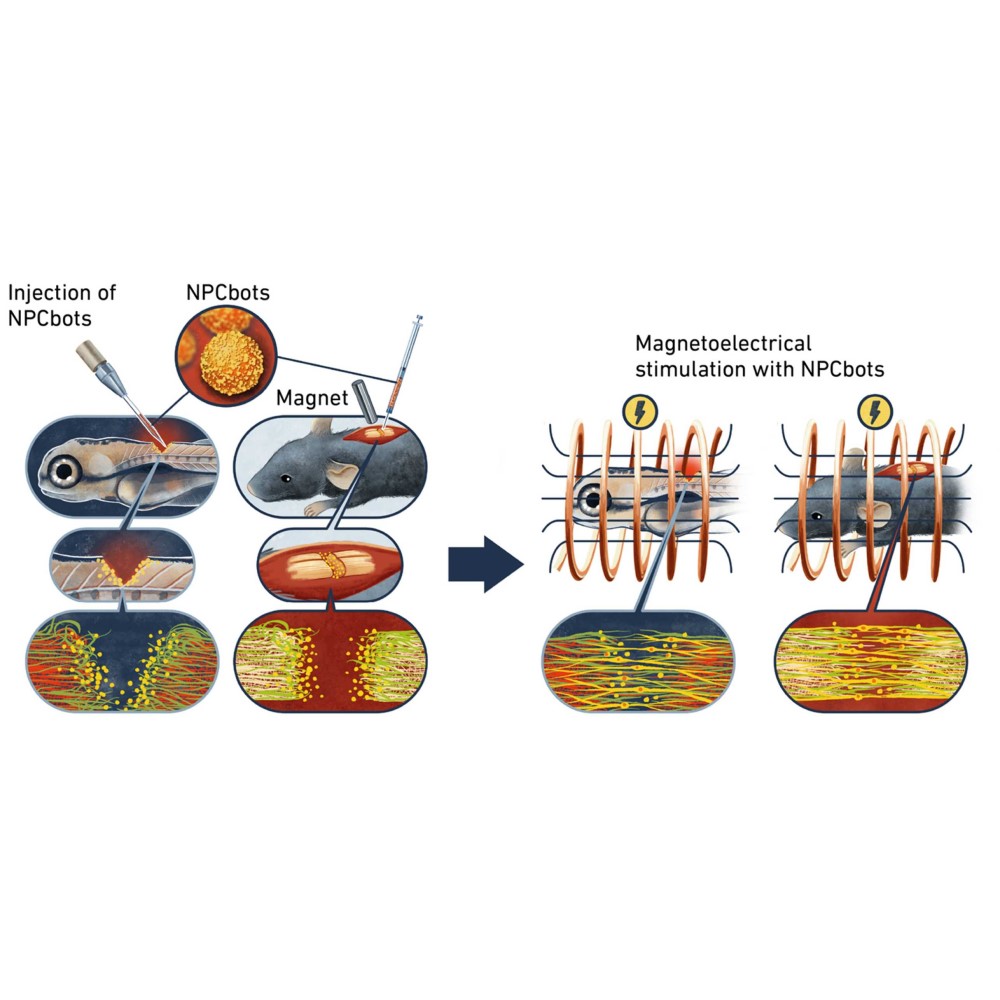
Researchers in Zurich are pursuing a new approach, which they have published in the journal Nature Materials. This involves combining therapeutic stem cells with magnetoelectric nanoparticles in such a way that the cells can be guided magnetically to the precise site of an injury and stimulate the stem cells to accelerate repair.
To achieve this, the researchers created a biohybrid microrobot, which combines living neural progenitor cells (NPCs) with a technical component in the form of specially engineered nanoparticles. The NPCs are derived from induced pluripotent stem cells (iPS cells), which are regular body cells reprogrammed in the laboratory to regain stem cell properties. These iPS cells have the potential to differentiate into various types of nervous system cells.
The nanoparticles consist of two layers: an inner layer that responds to magnetic fields and an outer layer that converts this response into electrical signals. By combining these special nanoparticles with the progenitor cells, the researchers fabricate what are known as NPCbots. The researchers create the NPCbots in specialised labs on a surface measuring one square centimetre. This process can be illustrated graphically. “We place a reservoir in the centre where we trap the cells. Then we inject the nanoparticles and wait for the two components to bind,” explains Professor Salvador Pané i Vidal of the Multi-Scale Robotics Lab at ETH Zurich.
After just thirty minutes, the NPCbots – each around six micrometres in size – are ready for use. “To scale up fabrication, we operate several lab-on-chip systems in parallel,” explains Hao Ye, senior scientist and the study’s first author. Depending on the test in question, the ETH researchers need hundreds of thousands of microrobots for cell-based studies and several million for animal experiments.
The researchers also tested the NPCbots on mice with completely severed spinal cords. Here, too, the results were very promising: after 28 days, the animals’ nerve cells had reconnected at the site of the injury. During this period, the treated mice exhibited increasingly normal movement patterns – their gait, stride length, coordination and exploratory behaviour improved significantly.
This result is particularly significant because, unlike in zebrafish, the mouse spinal cord does not normally regenerate. The treatment was well tolerated by the animals, with no evidence of any adverse effects or immune reactions.
These successes were made possible through electrical stimulation of stem cells, greatly enhancing their differentiation after transplantation. In this process, nanoparticles convert magnetic signals directly into electrical impulses that stimulate specific stem cells. When employing NPCbots, researchers need only apply external magnetic fields around the injury site, eliminating the need for implanted electrodes or cables in previous approaches. This is crucial because the spinal cord is extremely sensitive. The results from animal experiments are extremely promising, but further research will be needed before NPCbots can be tested in humans.
Tags:
Source: ETH Zurich
Credit: