World’s first birth after uterus transplantation with robot-assisted surgery alone
On May 26, 2023, the University of Gothenburg announced that for the first time worldwide, in yet another breakthrough by the world-leading research team at the University of Gothenburg, a child has been born following a uterus transplantation achieved solely by robot-assisted surgery on both donor and recipient.
The baby, a boy measuring 49 centimeters (19.3 inches) and weighing 3 100 grams (6 pounds 13 ounces), was delivered by planned cesarean section Thursday, May 25. The child and the rest of the family are well, as is the donor. The new mother is 35 years old, and the donor is a relative.
What distinguishes this case is the surgical method used in the transplantation itself. This time, the donor and recipient alike were operated on entirely by means of robot-assisted laparoscopic (keyhole) surgery — simply stated, “robot surgery” — with no open-surgery stage.
Robot surgery is considerably less invasive than traditional open surgery. In other types of operation, risks of infections and hemorrhages, for example, have proved to be lower when robot surgery is used. With it, in general, patients operated on get back on their feet faster.
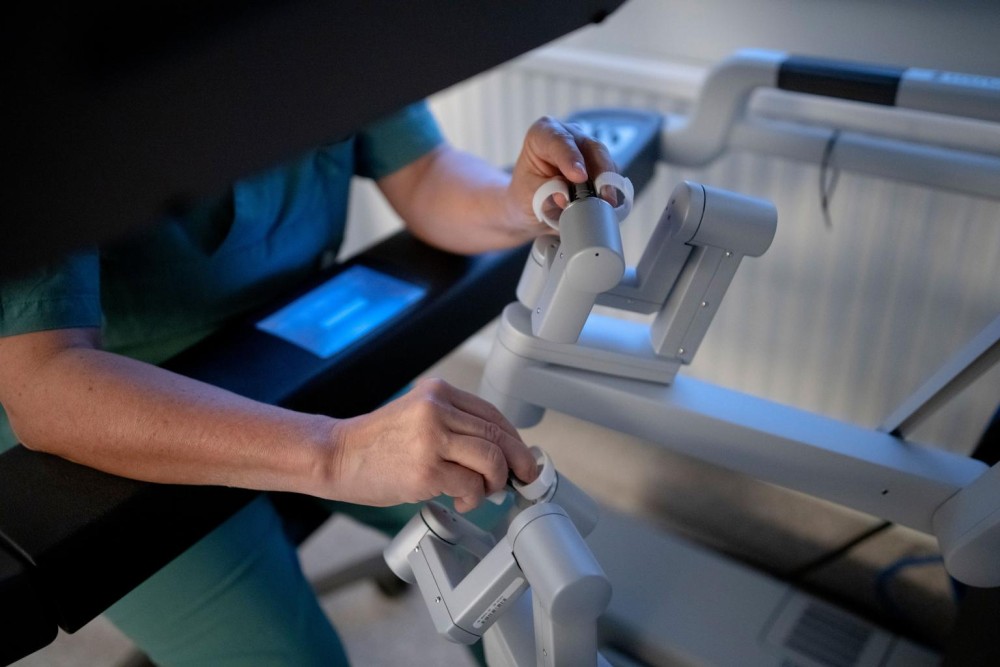
The method entails insertion of cameras and robotic arms with surgical instruments attached to them through small entry holes in the lower belly. The surgeons then steer the robotic arms by means of tools resembling joysticks at consoles, where they can simultaneously see mobile 3D images and operate with great precision.
In the present case, the transplantation was carried out at Sahlgrenska University Hospital in October 2021. In the donor, the uterus was freed one step at a time, supported by robot surgery. The last step involved detaching the uterus from its blood vessels and removing it vaginally in a laparoscopic pouch. In the recipient, it was then possible to insert the uterus into the woman’s pelvis through a small incision; first suture it with the blood vessels; and then suture it to the vagina and supportive tissue. All these steps were assisted by robot surgery.
Ten months later, an embryo created by in vitro fertilization (IVF) before the transplantation was inserted in the transplanted uterus, and a few weeks later pregnancy was verified. The mother-to-be felt well throughout her pregnancy, which has thus now concluded with a planned C-section in the 38th week.
Tags:
Source: University of Gothenburg
Credit: