World War I Killer Took Almost as Many US Troops’ Lives as Combat
On Aug. 29, 2018, one hundred years ago, there were two major killers in the world: World War I, which would claim 20 million lives by its end, and the Spanish flu epidemic is estimated to have killed between at least 50 million people. The flu struck an estimated 500 million people, some 28% of the world population.
American combat deaths in World War I totaled 53,402. But about 45,000 American soldiers died of influenza and related pneumonia by the end of 1918. More than 675,000 Americans died of influenza in 1918. Based on today’s population, that would be the equivalent of 2.16 million Americans dying.
The disease that launched the worldwide pandemic was known at the time as the Spanish influenza. Because Spain was not at war, newspapers there openly reported the virulent influenza. In the warring nations of Europe, information about the flu was kept out of newspapers so it did not hurt morale. But many medical historians say it’s likely the virus launched itself onto the world from Haskell County, Kansas, and the United States Army helped move it along to become a worldwide killer.
In January and February 1918, according to the 2005 book “The Great Influenza,” local Dr. Loring Miner found people in the sparsely populated county — 1,720 people occupying 578 square miles — were coming down with a particularly violent strain of flu. Strong, healthy people died. Miner was so concerned that in March 1918, he let the U.S. Public Health Service know what he had seen and warned of a new type of flu.
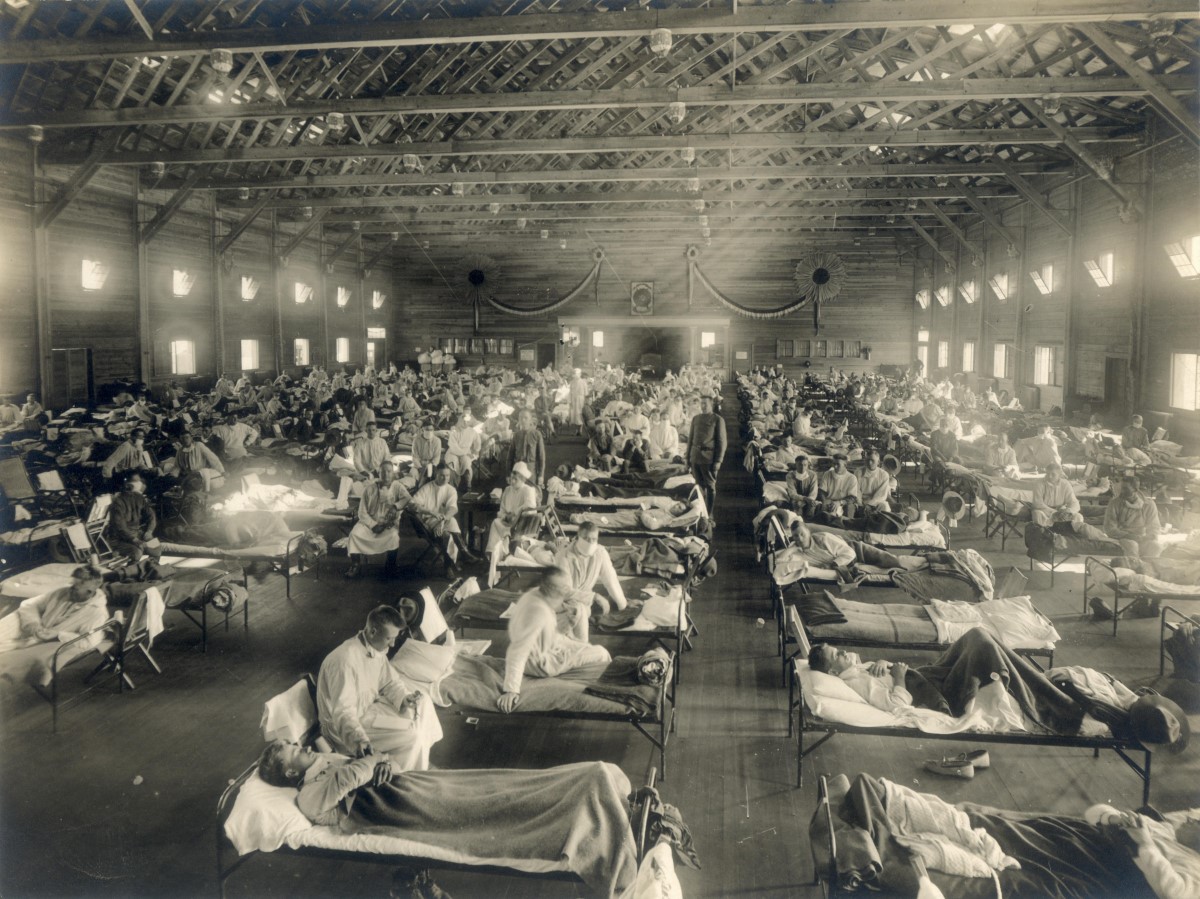
The disease burned itself out in March. In the past, it might well have never gotten beyond Haskell County. But in 1918, America was at war, and people were moving around the country more than ever. Young men from Haskell County were training nearby at Camp Funston, what is now Fort Riley, Kansas. They reported to the camp for duty and went back and forth from home when on leave. The local paper reported numbers of local boys on leave from Camp Funston while Miner was trying to figure out what was killing Haskell County residents in that fateful spring of 1918.
On March 4, 1918, the first influenza cases were identified at Camp Funston. Within three weeks, 1,100 of the 56,222 troops at the camp were sick. And because men were constantly moving among the Army’s camps all across the country, the virus spread. With the arrival of summer, the virus disappeared. But in the fall of 1918, it had mutated and came roaring back. Influenza appeared at Camp Syracuse in September. There had been some isolated cases in August, but the numbers began going up on Sept. 12 after 10,000 recruits from Massachusetts had shown up on Sept. 4, according to a report from the camp surgeon.
Influenza jumped outside the camps and went raging through the civilian population. Because of the way the virus worked, it was particularly frightening because it killed young men and women. Normally the flu killed the old and the very young. In 1918, the flu was killing young, able-bodied soldiers. One of those soldiers was Pvt. James Down, who entered the Camp Upton hospital on Long Island on Sept. 23 and died Sept 26. An Army pathologist clipped a piece of Down’s lung, preserved it in wax and sent it to the Army Medical Museum. In 1999, that section of Down’s lung helped doctors at the Armed Forces Institute of Pathology determine what made the 1918 virus so deadly. Researchers in 2007 theorized that the 1918 flu forced a victim’s overstimulated immune system to kill the patient as it tried to fight off the virus.
Tags:
Source: Military.com
Credit: Photo: Influenza outbreak Camp Funston, Kansas – Courtesy University of Michigan Center for the History of Medicine.