New atlas could help researchers studying neurological disease
On Jan. 22, 2026, researchers backed by a Knight Initiative for Brain Resilience Catalyst Momentum Award have laid out the first-ever atlas of lysosomal proteins in the brain, indicating which proteins are most closely associated with lysosomes across different brain cell types. That data, the researchers say, could help scientists better understand what lysosomes are up to and what happens when they break down.
Functioning brain cells need a functioning system for picking up the trash and sorting the recycling. But when the cellular sanitation machines responsible for those tasks, called lysosomes, break down or get overwhelmed, it can increase the risk of Alzheimer’s, Parkinson’s, and other neurological disorders.
The trouble is, scientists aren’t sure exactly how lysosomes do their work, what’s going wrong with lysosomes that leads to neurodegeneration – or even in which cell types neurodegenerative disease begins. There might even be other lysosomal disorders yet to be discovered.
The data has already yielded new results. As the team reported in Cell, they used the atlas to tie a rare neurological disorder, SLC45A1-associated disease, to lysosomal dysfunction. And, with a dedicated website where others can access the data, that’s just the beginning, said Monther Abu-Remaileh Abu-Remaileh, a Wu Tsai Neuro affiliate and an assistant professor of chemical engineering in the Stanford School of Engineering and an assistant professor of genetics in the Stanford School of Medicine.
The team built their atlas: a catalog of 790 proteins associated with lysosomes – that is, more likely to be found in lysosomes than elsewhere – along with data on which proteins were more likely to be found in which types of brain cells.
That atlas presented the researchers with an unusual opportunity to explore connections between lysosomal proteins, the genes that encode them, and neurodegenerative disease. In particular, the team found 67 lysosomal proteins associated with Alzheimer’s-related dementia, Parkinson’s disease, and lysosomal storage disorders. A few of those proteins, further analysis showed, were expressed more in one cell type than others – for example, a protein called GRN associated with frontotemporal dementia was more common in microglia, a kind of immune cell that has been linked to neurodegeneration, than others.
Another protein in the list raised the team’s eyebrows. The researchers knew that protein SLC45A1 helps transport sugars across cell membranes and that mutations in the protein cause intellectual disabilities with neuropsychiatric symptoms – but no one had previously connected it to the lysosome or lysosome dysfunction.
Tags:
Source: Stanford University
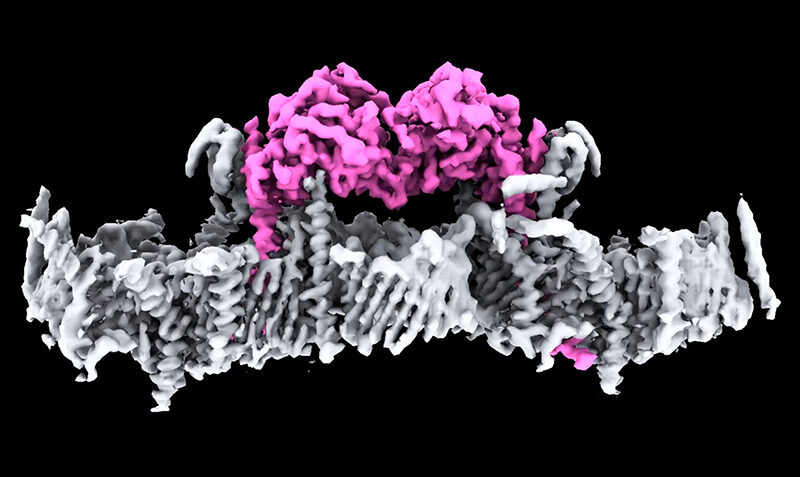
Credit: Image: Two PINK1 proteins are shown attached to the membrane of a mitochondrion for the first time. Courtesy: Walter and Eliza Hall Institute & American Association for the Advancement of Science.