January brought an Increase in influenza Epidemic in Philadelphia
Jan. 1, 1919, brought an increase in the influenza epidemic in Philadelphia and Pittsburgh. With the disease having run so rampant in the fall, however, the cases and deaths were fortunately far fewer than Philadelphia had seen just a few months earlier.
With one hundred years of hindsight, today Philadelphia’s battle with the 1918 influenza epidemic is often seen as an example of what not to do. In particular, the decision to allow the Fourth Liberty Loan Parade to take place right as the city’s epidemic was about to accelerate is held up as an object lesson in poor public health decision-making.
To be sure, that fateful parade decision greatly aided the rapid and overwhelming spread of influenza throughout the city in the days after September 28, 1918. On the eve of the fated parade, there were only a few dozen civilian influenza in the city, and the epidemic seemed mostly confined to the Philadelphia Navy Yard. More than a lack of public health foresight, Philadelphia was the victim of incredibly poor timing and bad luck. In the end, the city experienced a excess death rate of 748 deaths per 100,000 population, one of the worst in the nation. Philadelphia’s epidemic outcome was largely shaped by two factors: its location as an East Coast city, and its insistence on holding the fateful Fourth Liberty Loan Parade at the exact moment that the influenza epidemic was growing.
Pittsburgh continued to experience cases of influenza and pneumonia throughout the rest of the winter, with a small spike in late-January 1919 that briefly concerned health officials. By the start of February, more than 25,000 Pittsburghers had contracted influenza. It was not until April 21, 1919 that the city celebrated its first flu-free 48-hours since the epidemic started, some seven months earlier.
Overall, Pittsburgh experienced the worst epidemic of any major city in the United States. The average death rate for Eastern cities was 555 per 100,000. By contrast, Pittsburgh’s excess death rate was a whopping 807 per 100,000 people. The Steel City’s ordeal with influenza was even deadlier than that of Philadelphia (748) or Boston (710), two communities where influenza ran rampant in the fall of 1918.
There are several significant differences between Pittsburgh and either Philadelphia or Boston, however, that may account for the more severe epidemic in the Steel City. Both Philadelphia and Boston closed schools earlier in their epidemics. Pittsburgh, on the other hand, waited three weeks after implementing other closure orders to extend those closures to schools as well. As a result, Pittsburgh’s various social distancing measures were staggered, and only overlapped by two weeks. Modern epidemiological studies of the 1918 epidemic show that the early, sustained, and layered implementation of such social distancing measures had an impact on the severity of a city’s peak and overall influenza and pneumonia mortality.
It is also possible that Pittsburgh’s high death rate was in part due to the city’s notoriously poor air quality during the time. A lifetime of exposure to heavy smoke pollution from the city’s coal-fed steel mills may have left many residents more susceptible to respiratory complications from influenza. Several studies over the decades since the 1918 epidemic have shown that historically, Pittsburgh suffered from higher rates of pneumonia than did other areas of the state, especially in the fall and winter months when the weather kept pollution trapped over the city. Other, more recent studies have concluded that high pneumonia mortality is frequently observed in communities with heavy air pollution. Combined with the delay in closing schools, Pittsburgh’s pollution may have contributed to the severity of its bout with influenza in 1918.
.
Tags:
Source: Influenza Encyclopedia
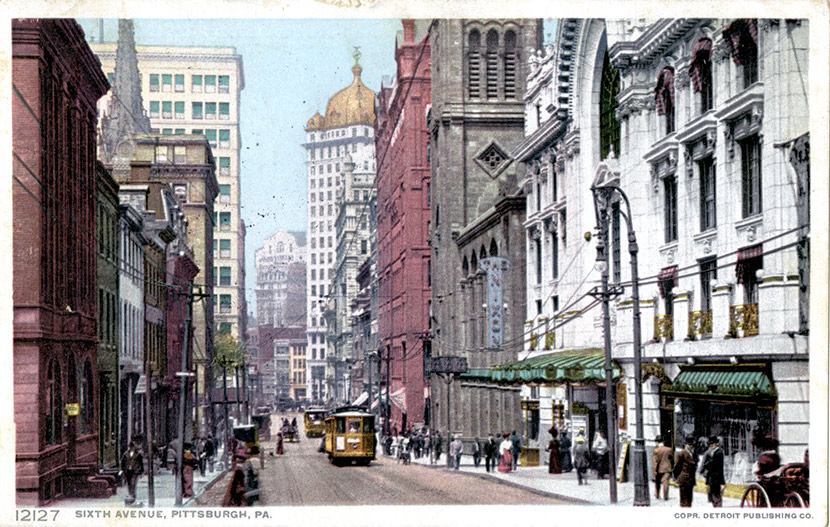
Credit: Image: Postcard of 6th Ave., Pittsburgh, PA, Courtesy University of Michigan Center for the History of Medicine.