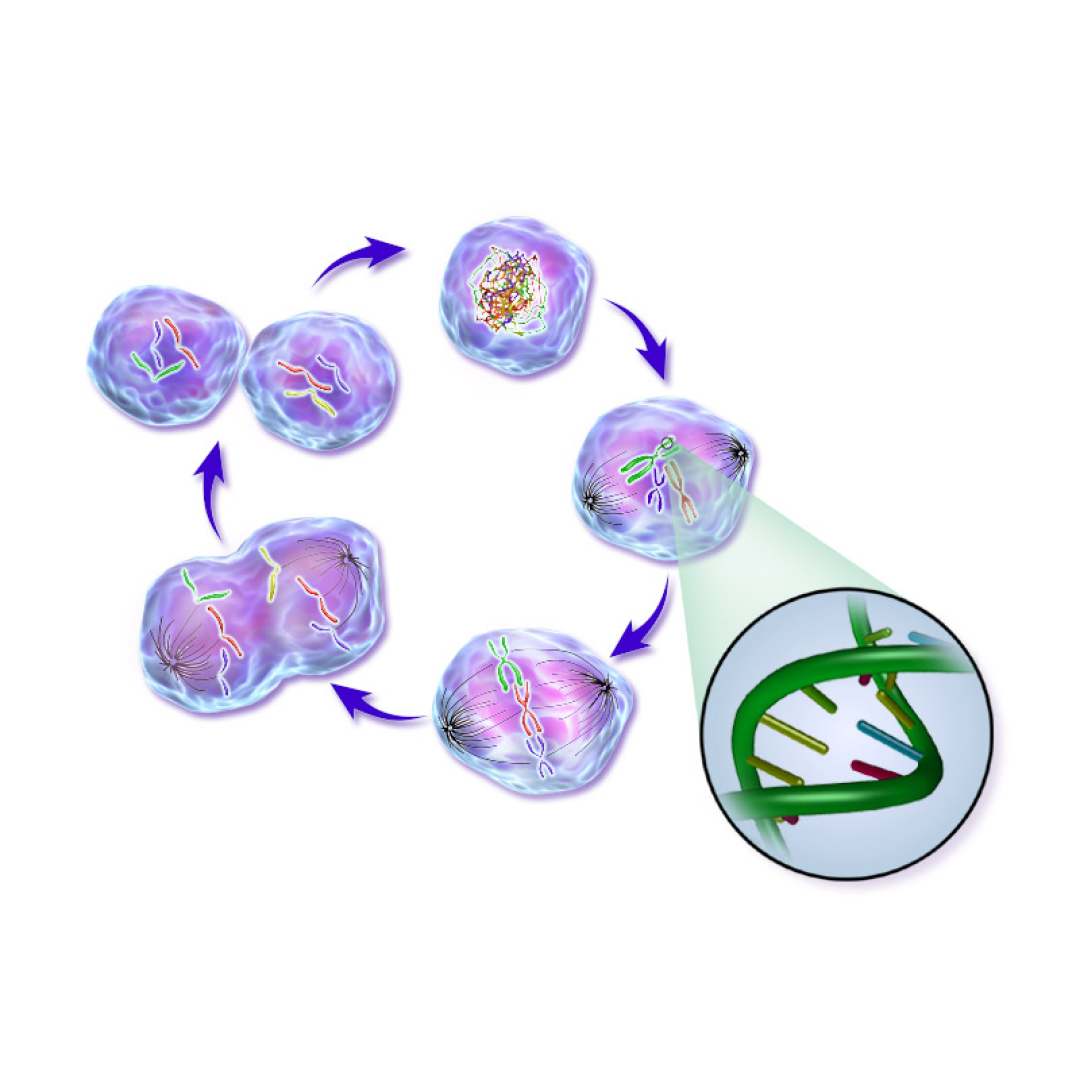
A team of OMRF researchers led by Gary Gorbsky found a way to turn back cell division
On Apr. 18, 2016, a team of Oklahoma Medical Research Foundation (OMRF) researchers led by Gary Gorbsky found a way to turn back cell division. The discovery could have important implications in treating cancer and birth defects. The study was published in the scientific journal eLife.
The average human body is made up of around 47 trillion cells. Each day millions of cells die naturally. So millions of them must divide into two new cells to replace them for life to continue. While it may sound simple, cell division requires precise timing to avoid catastrophic results, like cancer, where cells divide unchecked, or birth defects caused by an incorrect number of chromosomes.
In previous work, Gorbsky studied a group of proteins called the Ska complex that he knew played a key role in cell division. Gorbsky has now found that the Ska complex recruits PP1 to act as a sort of “starting gun” that tells cells when to separate.
“One of Ska’s major jobs is to bring this enzyme to the right location on the chromosomes so it can give this ‘go’ signal inside the cell,” said Gorbsky, who also serves as head of OMRF’s Cell Cycle and Cancer Biology Research Program. “We know the Ska complex drives the process, and now that we’ve identified PP1, we can learn a lot more about how it is regulated and the factors that coordinate it.”
There are still huge gaps in our understanding of cell division, said Gorbsky, but discoveries like this new one help researchers piece together the complex puzzle. Ultimately, scientists hope to learn how and why cell division goes wrong and devise ways to correct it, which could lead to new ways to treat or prevent conditions like birth defects and cancer.
Tags:
Source: Oklahoma Medical Research Foundation
Credit: Image courtesy Oklahoma Medical Research Foundation.