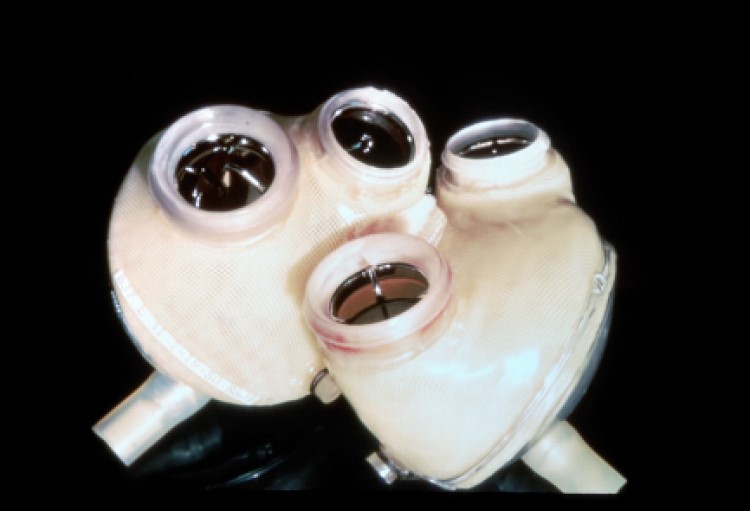
A University of Utah team successfully implanted the Jarvik-7 into Seattle dentist Barney Clark
On Dec. 2, 1982, a team led by William DeVries, at the University of Utah, successfully implanted the Jarvik-7 into 38 year old Seattle dentist Barney Clark. He survived with the Jarvik-7 for 112 days. Known as the Jarvik-7 (named after former U of U physician and inventor Robert Jarvik, MD), this aluminum and polyurethane device was connected to a 400-pound air compressor.
At the time, such a move was associated with the significance of putting a man on the moon or seeing Saturn’s rings for the first time. It captivated the world. Others equated it with Frankenstein-like aspects, raising bioethical questions and concerns.
During the seven-hour operation, reporters from around the world set up their press headquarters in the hospital cafeteria, draining the coffee supply. The entire world held their breath, as Clark began his final journey, pioneering a new frontier of medicine involving the most symbolic of all our organs, the heart.
A dentist and “tough old guy” from Seattle, Clark was hailed as a hero as the world witnessed him weathering hard days and enjoying some good ones too. Celebrating his 39th anniversary with his wife, Una Loy, and their children was one of the good days.
Quite suddenly, on March 23, 1983, Clark passed away at the age of 62. At the time, the cause of death was stated as “circulatory collapse and secondary multi-organ system failure.” He left behind a legacy. Clark’s willingness to pioneer this new device infused life into mechanical heart device research and challenged all of us to open our minds and question, “what is possible?”
Tags:
Source: University of Utah
Credit: