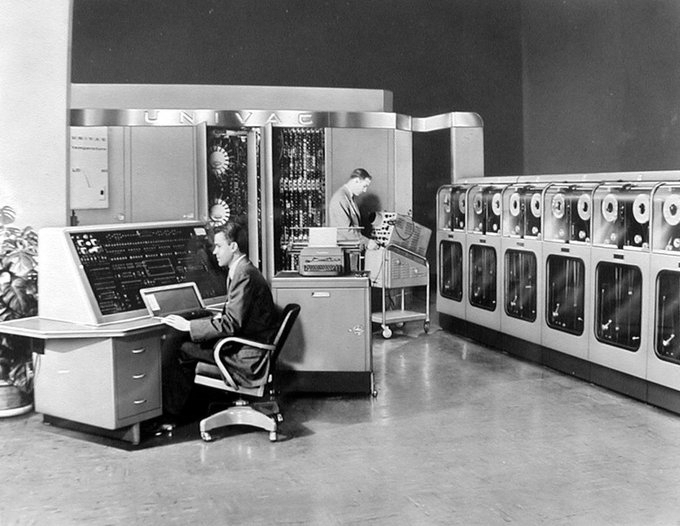
The University of California Radiation Laboratory (Livermore) acquired Univac, the Lab’s first computer
On Mar. 1, 1953, the University of California Radiation Laboratory (UC Berkeley), now known as the Lawrence Livermore National Laboratory (LLNL) acquired the Univac-1, and soon after the IBM 701 – the beginning of the Laboratory’s not-so-coincidental links to commercial supercomputing – their nearly identical birth dates, efforts to develop the fastest and most powerful machines, and use of machines to solve large, complex problems.
While the Univac-1 was a simple machine to program, the IBM 701 was much more difficult to use, with a reliance on punch cards for input and output. To address these issues, IBM established a project under the leadership of John Backus to develop an “automatic programming” system called FORTRAN (formula translation) that would convert programs in a mathematical notation to machine instructions.
in October 1956, the first manual for FORTRAN was issued and the first FORTRAN compiler was delivered in April 1957. FORTRAN became the first computer language standard, and it helped open the door to modern computing. Earlier machine language programs had to be coded for a specific computer, while a FORTRAN program could be run on any machine with a FORTRAN compiler. So too, FORTRAN made code comprehensible for people with expertise in areas other than computing, opening computer programming to mathematicians and scientists.
In 1958, after the death of E. O. Lawrence, the Livermore Lab was renamed Lawrence Radiation Laboratory.
Tags:
Source: Lawrence Livermore National Laboratory
Credit: