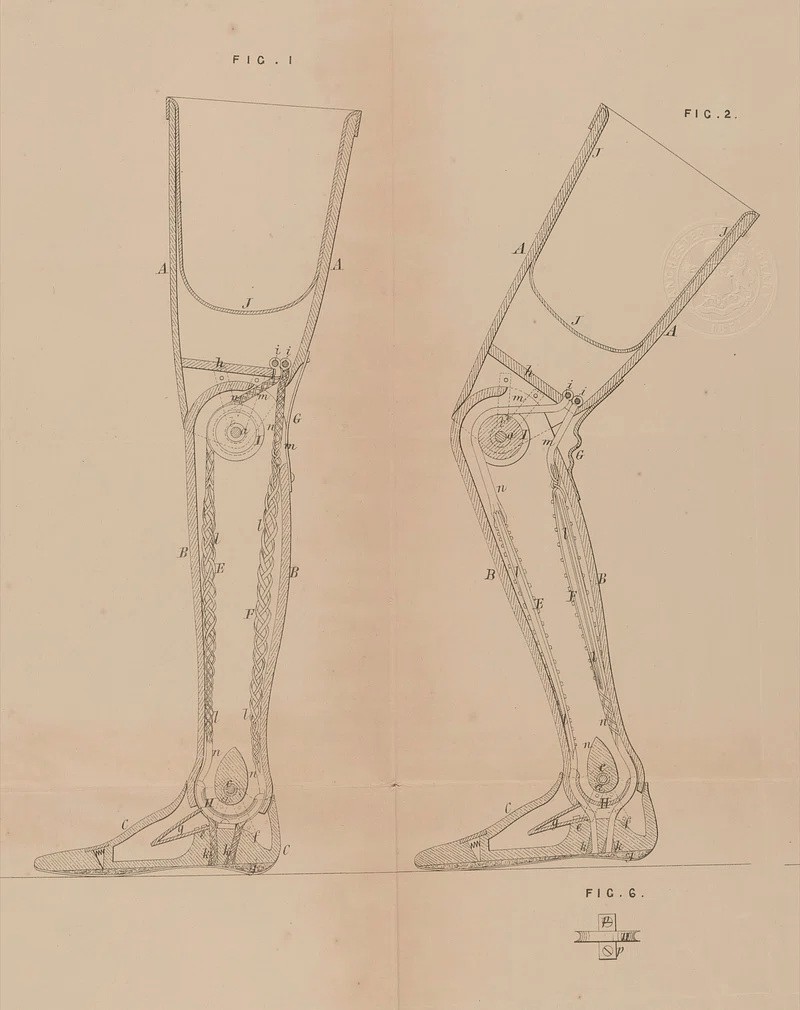
The ‘Hanger Limb’ received a U.S. patent
On Feb. 4, 1871, James Edward Hanger, one the first amputees of the American Civil War, received a U.S. patent for the ‘Hanger Limb.’ Hanger was one of the first recorded amputations at the start of the Civil War, one of over 50,000 in four years. In August 1861, he was returned to his family home in Norfolk, Virginia in a prisoner of war exchange. By the end of the year, Mr. Hanger began manufacturing the devices to aid fellow wounded soldiers.
Prosthetics in the 19th century were expensive, uncomfortable, and largely dysfunctional. Made of metal and wood, many were inflexible affecting an amputee’s mobility and function. Additionally, for many, the loss of a limb meant the loss of independence, and the ability to provide for a family in a factory or on the farm. In other words the loss of manhood.
As an engineering student prior to the war, he worked to do something about it. Over the course of a few months, Hanger designed a better artificial limb using oak barrel staves, rubber bumpers, and nails to create a prosthetic limb that was able to bend at the knee and the ankle. With the success of his prototype, James took his “Hanger Limb” and opened up a shop in Staunton, Virginia, with one of his brothers to begin helping fellow Confederate soldiers with more comfortable prosthetic limbs at a more reasonable rate.
Just over a year later, Hanger had filed and received a design patent (No. 155) for an “Artificial Leg” through the Confederate Patent office. A second patent was issued a few months later in August 1863. In the years following the war, Hanger continued to expand and perfect his product, opening a branch of his business in Richmond and receiving a U.S. Patent (111,741) in February 1871. By the turn of the century the “Hanger Limb” was one of the most popular prosthetic limbs and it was winning awards.
By the time of James Hanger’s death in 1919, he had built a company that later become a billion-dollar company that helps over half a million patients annually. In 1989, J. E. Hanger of Washington, D.C., was purchased by Hanger Orthopedic Group and became part of their wholly owned subsidiary, Hanger Prosthetics and Orthotics.
Tags:
Source: American Battlefield Trust
Credit: