Failed experiment leads to surprise drug development breakthrough
On Mar. 12, 2026, scientists at the University of Cambridge announced they have developed a new way to alter complex drug molecules using light rather than toxic chemicals – a discovery that could accelerate and improve how medicines are designed and made.
Published in Nature Synthesis, the study introduces what the team calls an “anti-Friedel–Crafts” reaction. A classic Friedel–Crafts reaction uses strong chemicals or metal catalysts under harsh experimental conditions. This means the reaction can only happen in the early stages of drug manufacturing, and is followed by many additional chemical steps to produce the final drug.
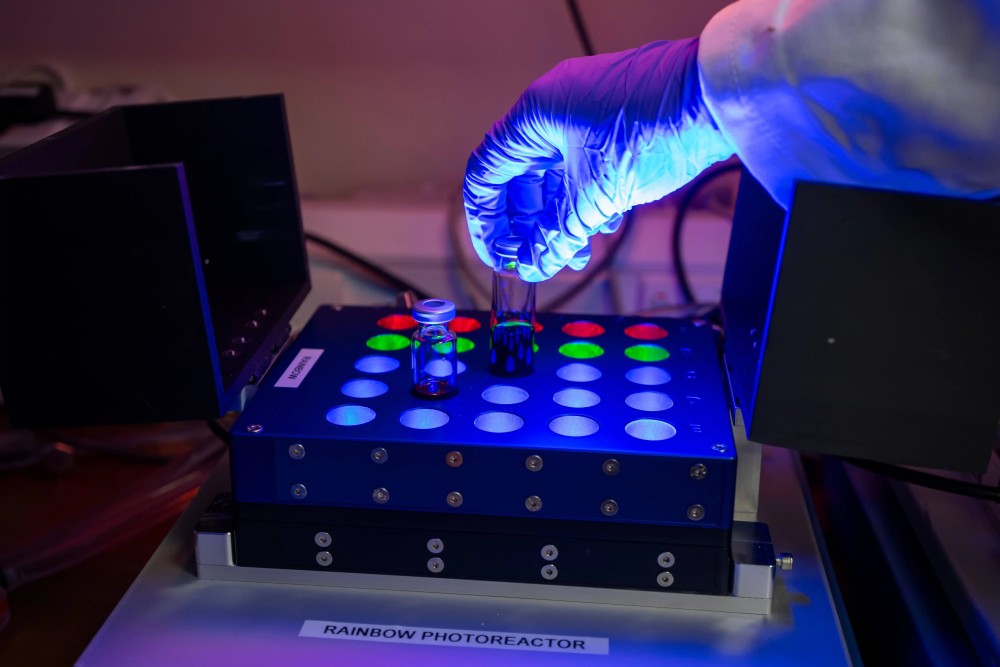
The new Cambridge approach reverses that pattern, allowing scientists to modify drug molecules at the final stages of production. Rather than relying on heavy metal catalysts, the chemistry is powered by an LED lamp at ambient temperature. When activated, it triggers a self-sustaining chain process that forges new carbon–carbon bonds under mild conditions and without toxic or expensive chemicals.
In practical terms, this means chemists can make targeted changes late in the development of a new or existing drug rather than dismantling and rebuilding complex molecules from scratch – a process that can otherwise take months.
The Cambridge breakthrough tackles one of the most fundamental steps in that process: forming carbon–carbon bonds, the links that underpin everything from fuels to complex biomolecules.
The method is highly selective, meaning it can alter one part of a molecule without disturbing other sensitive regions – what chemists call “high functional-group tolerance”. That makes it particularly suited to late-stage optimisation – a key part of modern medicinal chemistry, where scientists fine-tune molecules to improve how drugs perform.
By avoiding heavy metal catalysts, hazardous conditions and reducing the need for long synthetic sequences, the reaction could also dramatically cut toxic chemical waste and energy use in pharmaceutical development, which is an increasing priority as the industry seeks to reduce its environmental footprint.
Tags:
Source: St John’s College Cambridge
Credit: Photo: Rainbow Photoreactor chemistry is powered by an LED lamp that triggers a self-sustaining chain reaction, forging new carbon–carbon bonds without toxic or expensive chemicals. Credit: Nordin Ćatić.