The Priestley Medal was awarded to M. Frederick Hawthorne
On Jun. 18, 2008, the American Chemical Society announced M. Frederick Hawthorne, director of the International Institute of Nano & Molecular Medicine at the University of Missouri, Columbia, and longtime editor-in-chief of Inorganic Chemistry, will receive the 2009 Priestley Medal.
Hawthorne, a native of Kansas, completed his undergraduate education in 1949 at Pomona College, in Claremont, Calif., and earned a Ph.D. in physical organic chemistry in 1953 from the University of California, Los Angeles. He began to synthesize and study polyhedral borane clusters such as B12H122– in 1956 while working at Rohm and Haas. Back then, no one knew much about boron chemistry, Hawthorne says. He assumed that it should be possible to do anything with boron that could already be done with its next-door neighbor, carbon. And the assumption paid off.
During his nearly 60-year career, which includes stints UC Riverside and UCLA, Hawthorne and his colleagues have created a diverse collection of boranes and spin-off compounds, including the carboranes, such as C2B10H12, and the metallacarboranes, such as Ni(C2B9H12)2. Hawthorne has put these compounds to work in applications as varied as medical imaging, drug delivery, neutron-based radiation treatments for cancers and rheumatoid arthritis, catalysis, and nanomachines.
The accomplishment Hawthorne is most excited about is the creation of nontoxic carborane-containing liposomes that selectively target cancer cells for destruction by boron neutron capture therapy (BNCT). But for most of his career, Hawthorne did not have access to a neutron source suitable to test the compounds’ efficacy. That shortfall prompted Hawthorne to pull up his roots at UCLA two years ago and move to Missouri, which made a research neutron beam line available to his research team.
Tags:
Source: American Chemistry Society
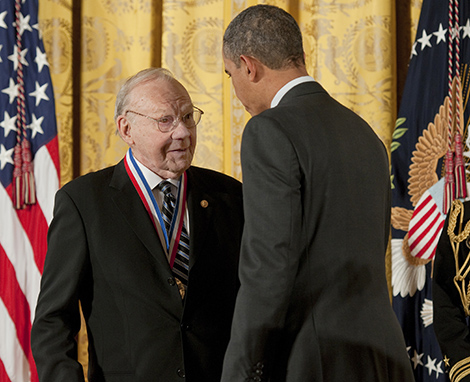
Credit: Photo: Frederick Hawthorne, National Medal of Science award. Courtesy: Missouri University News Bureau.