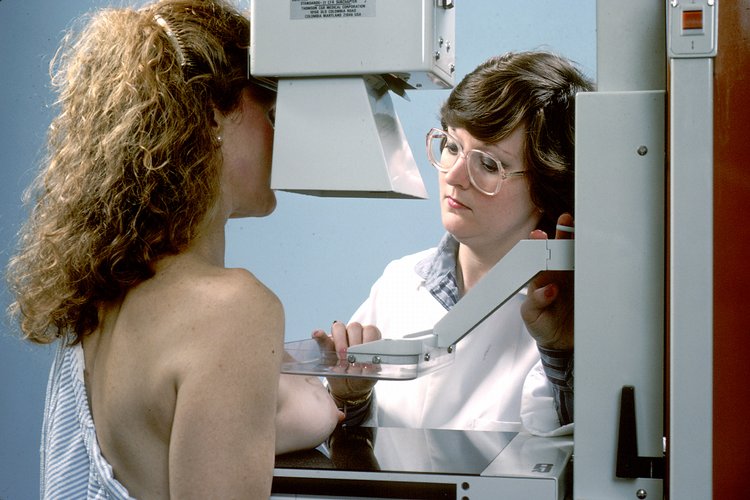
Preliminary results from clinical trial of digital vs. film mammography showed no difference in breast cancer detection
On Sept. 16, 2005, preliminary results from a large, clinical trial of digital vs. film mammography showed no difference in detecting breast cancer for the general population of women in the trial. However, those women with dense breasts, who are pre- or perimenopausal (women who had a last menstrual period within 12 months of their mammograms), or who are younger than age 50 may benefit from having a digital rather than a film mammogram.
A total of 49,528 asymptomatic women presenting for screening mammography at 33 sites in the United States and Canada underwent both digital and film mammography. All relevant information was available for 42,760 of these women (86.3 percent). Mammograms were interpreted independently by two radiologists. Breast-cancer status was ascertained on the basis of a breast biopsy done within 15 months after study entry or a follow-up mammogram obtained at least 10 months after study entry. Receiver-operating-characteristic (ROC) analysis was used to evaluate the results.
In the entire population, the diagnostic accuracy of digital and film mammography was similar (difference between methods in the area under the ROC curve, 0.03; 95 percent confidence interval, –0.02 to 0.08; P=0.18). However, the accuracy of digital mammography was significantly higher than that of film mammography among women under the age of 50 years (difference in the area under the curve, 0.15; 95 percent confidence interval, 0.05 to 0.25; P=0.002), women with heterogeneously dense or extremely dense breasts on mammography (difference, 0.11; 95 percent confidence interval, 0.04 to 0.18; P=0.003), and premenopausal or perimenopausal women (difference, 0.15; 95 percent confidence interval, 0.05 to 0.24; P=0.002).
These results may give clinicians better guidance and greater choice in deciding which women might benefit most from various forms of mammography.
The overall diagnostic accuracy of digital and film mammography as a means of screening for breast cancer is similar, but digital mammography is more accurate in women under the age of 50 years, women with radiographically dense breasts, and premenopausal or perimenopausal women
Tags:
Source: New England Journal of Medicine
Credit: