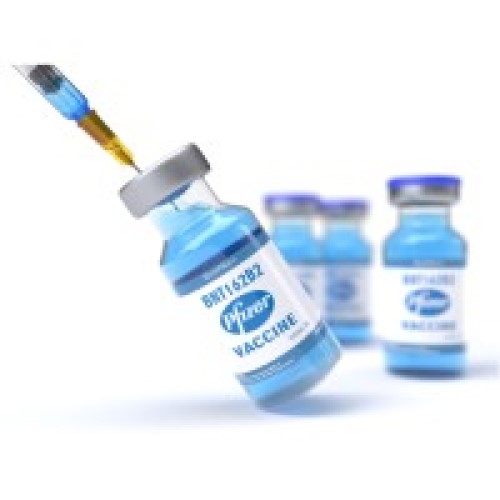
Pfizer and BioNTech received first U.S. FDA Emergency Use Authorization of a COVID-19 vaccine booster
On Sept. 23, 2021, Pfizer and BioNTech announced that the U.S. Food and Drug Administration (FDA) has authorized for emergency use a booster dose of the Pfizer-BioNTech COVID-19 Vaccine for individuals 65 years of age and older, individuals 18 through 64 years of age at high risk of severe COVID-19, and individuals 18 through 64 years of age whose frequent institutional or occupational exposure to SARS-CoV-2 puts them at high risk of serious complications of COVID-19 including severe COVID-19. The booster dose was to be administered at least six months after completion of the primary series, and is the same formulation and dosage strength as the doses in the primary series.
The FDA based this EUA on the totality of scientific evidence shared by the companies and reviewed by the FDA’s Vaccines and Related Biological Products Advisory Committee (VRBPAC), including data from the Pfizer-BioNTech clinical program evaluating the safety, tolerability and immunogenicity of a booster dose of the COVID-19 vaccine. A booster dose of the vaccine elicited significantly higher neutralizing antibody titers against the initial SARS-CoV-2 virus (wild type), as well as the Beta and Delta variants, when compared with the levels observed after the two-dose primary series. The reactogenicity profile within seven days after the booster dose was typically mild to moderate, and the frequency of reactions was similar to or lower than after dose two. The adverse event profile was generally consistent with other clinical safety data for the vaccine.
As a next step, the U.S. Centers for Disease Control and Prevention’s (CDC) Advisory Committee on Immunization Practices (ACIP) will meet to discuss a potential recommendation for the use and rollout of boosters to Americans.
Pfizer and BioNTech continue to supply the vaccine, including sufficient volume for boosters, under their existing supply agreement with the U.S. government, which continues through April 2022. The companies do not expect the introduction of booster doses in the U.S. to impact the existing supply agreements in place with governments and international health organizations around the world. Pfizer and BioNTech have pledged to provide two billion doses to low- and middle-income countries in 2021 and 2022 – at least one billion doses each year.
Under the EUA in the U.S., a third dose of the vaccine was previously authorized for individuals at least 12 years of age who have undergone solid organ transplant, or who are diagnosed with conditions that are considered to have an equivalent level of immunocompromise. This authorization of a third dose for immunocompromised individuals – administered at least 28 days following the second dose – is separate and distinct from the booster dose authorized today. The third dose for immunocompromised individuals is meant to address the fact that these individuals sometimes do not build enough protection after two doses of the vaccine. In contrast, the booster dose authorized today refers to an additional dose of the vaccine that is given to those who have built enough protection after the primary vaccination series, but may have decreased protection over time due to waning of immunity.
The Pfizer-BioNTech COVID-19 Vaccine, which is based on BioNTech’s proprietary mRNA technology, was developed by both BioNTech and Pfizer. BioNTech is the Marketing Authorization Holder in the United States, the European Union, the United Kingdom, Canada and the holder of emergency use authorizations or equivalents in the United States (jointly with Pfizer) and other countries. Submissions to pursue regulatory approvals in those countries where emergency use authorizations or equivalent were initially granted are planned.
The vaccine is administered as a 2-dose series, 3 weeks apart. A third dose may be administered at least 4 weeks after the second dose to individuals who are determined to have certain kinds of immunocompromise.
Tags:
Source: BioNTech
Credit: