Bacterial cells transmit their memories to offspring
On Aug. 28, 2024, Northwestern University and University of Texas-Southwestern announced results of a study that found bacterial cells can “remember” brief, temporary changes to their bodies and immediate surroundings. Researchers found these changes are not encoded in the cell’s genetics, but the cell still passes memories of them to its offspring — for multiple generations.
Not only does this discovery challenge long-held assumptions of how the simplest organisms transmit and inherit physical traits, it also could be leveraged for new medical applications. For example, researchers could circumvent antibiotic resistance by subtly tweaking a pathogenic bacterium to render its offspring more sensitive to treatment for generations. The study was published in the journal Science Advances.
“A central assumption in bacterial biology is that heritable physical characteristics are determined primarily by DNA,” said Northwestern’s Adilson Motter, the study’s senior author. “But, from the perspective of complex systems, we know that information also can be stored at the level of the network of regulatory relationships among genes. We wanted to explore whether there are characteristics transmitted from parents to offspring that are not encoded in DNA, but rather in the regulatory network itself. We found that temporary changes to gene regulation imprint lasting changes within the network that are passed on to the offspring. In other words, the echoes of changes affecting their parents persist in the regulatory network while the DNA remains unchanged.”
The research team used a mathematical model of the regulatory network to simulate the temporary deactivation (and subsequent reactivation) of individual genes in E. coli. They discovered these transient perturbations can generate lasting changes, which are projected to be inherited for multiple generations. The team currently is working to validate their simulations in laboratory experiments using a variation of CRISPR that deactivates genes temporarily rather than permanently.
But if the changes are encoded in the regulatory network rather than the DNA, the research team questioned how a cell can transmit them across generations. They propose that the reversible perturbation sparks an irreversible chain reaction within the regulatory network. As one gene deactivates, it affects the gene next to it in the network. By the time the first gene is reactivated, the cascade is already in full swing because the genes can form self-sustaining circuits that become impervious to outside influences once activated.
Tags:
Source: Northwestern University
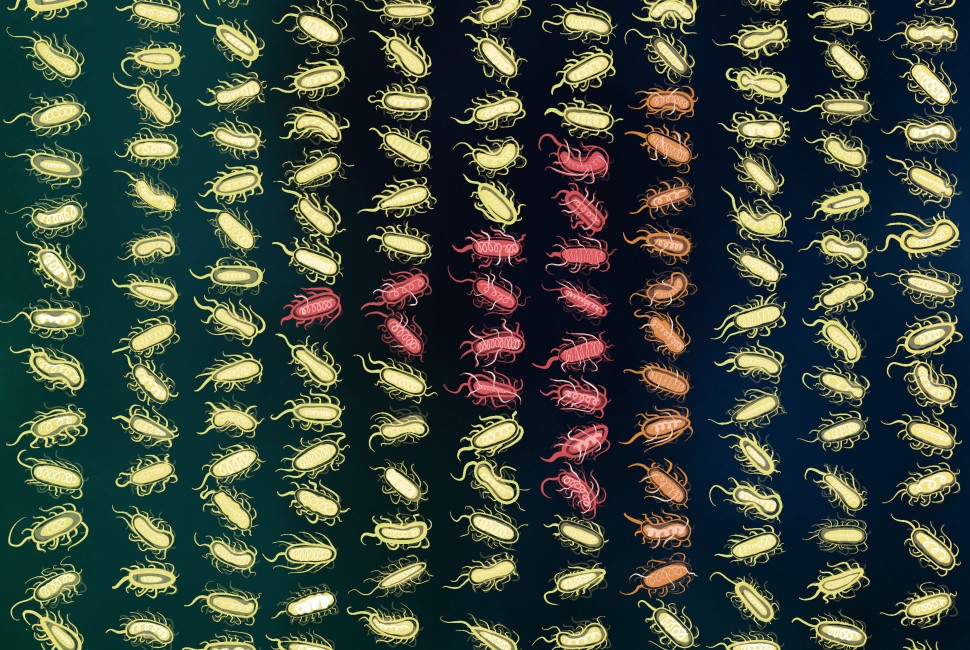
Credit: Image: Illustration depicting bacterial cells passing memories to multiple generations of offspring, Courtesy Camila Felix