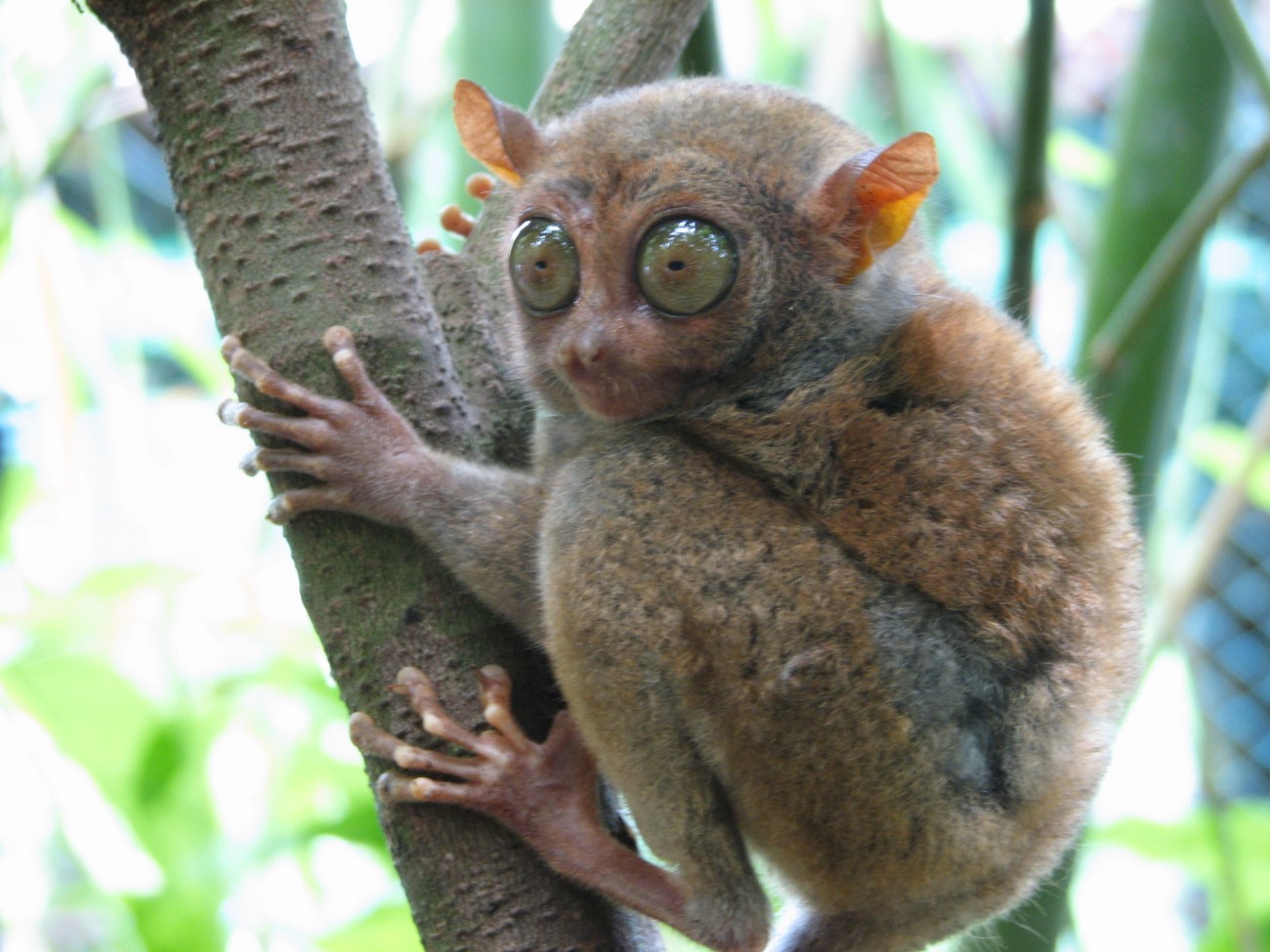
Tarsier genome was sequenced by Washington University School of Medicine researchers
On Oct. 6, 2016, Washington University School of Medicine researchers announced they had sequenced the genome of the Tarsier, a primate small enough to fit into the palm of your hand, with enormous eyes and an appetite for meat. The findings, published in Nature Communications, placed tarsiers on a branch of the evolutionary tree that leads to monkeys, great apes and humans.
Small enough to fit into the palm of your hand, with enormous eyes and an appetite for meat, tarsiers are an anomaly of nature. They are also our distant cousins, according to scientists at Washington University School of Medicine in St. Louis, who recently sequenced and analyzed the tarsier genome.
Tarsiers are the only exclusively carnivorous primate; they eat insects, small birds, rodents and lizards. With eyes twice as big as their brains, a head that can rotate 180 degrees in each direction and the ability to track prey using ultrasound, the tiny animals are formidable nocturnal hunters. Their legs and feet are adapted for sudden, powerful leaps, with an elongated ankle bone, the tarsus, for which they are named.
The position of tarsiers among primates has been considered controversial. Their teeth and jaws are more similar to “wet-nosed” primates such as lemurs, but their eyes and noses are more similar to “dry-nosed” primates such as monkeys and humans.
By sequencing the complete genome of a tarsier, Warren, Jürgen Schmitz of the University of Münster in Germany, and colleagues definitively placed tarsiers in the dry-nosed category.
The researchers analyzed DNA sequences known as transposons, or “jumping genes,” which can jump from one part of the genome to another, often duplicating themselves in the process. Over time, transposons lose the ability to jump. Newer transposons can jump into older transposons, but not vice versa. By analyzing which transposons were embedded inside others, the researchers were able to determine when particular families of transposons lost the ability to jump and thereby date the different families of transposons.
The researchers compared the transposon families of tarsiers, humans, bushbabies (a wet-nosed primate) and squirrel monkeys (a dry-nosed primate). Tarsiers shared more recent transposon families with squirrel monkeys and humans, and only the oldest ones with bushbabies, indicating that tarsiers belong with the dry-nosed primates.
Tags:
Source: Washington University School of Medicine
Credit: