NIH announced it would no longer support biomedical research on chimpanzees
On Nov. 17, 2015, the National Institutes of Health (NIH). announced that since Jun. 2013, based on recommendations from the Council of Councils, the NIH has phased out all previously active biomedical research protocols using chimpanzees that did not meet the Institute of Medicine principles and criteria, and no new biomedical research projects had been approved.
The NIH has developed a plan for the retirement of all of the NIH-owned and -supported chimpanzees to Chimp Haven, the Federal Sanctuary, over the next decade. Chimp Haven has a capacity of approximately 230 animals, and currently has room for approximately 25^^ additional chimpanzees. This information along with modeling of the natural attrition in this aging population has been used to develop estimates for the number of chimpanzees that can be transferred to the Federal Sanctuary each year. The prioritization of chimpanzees for relocation in the plan is based on animal health and wellbeing, including animals’ social grouping.
The plan also assumes that the transfer of chimpanzees to the Federal Sanctuary will be done in accordance with the CHIMP Act, as amended (42 U.S.C. § 283m). In April 2016, the priority of transfers was provided to the NIH-supported facilities that maintain chimpanzees: the Alamogordo Primate Facility (APF), the Keeling Center for Comparative Medicine and Research (KCCMR), the Southwest National Primate Research Center (SNPRC), and the Federal Sanctuary operated by Chimp Haven, Inc. (Chimp Haven). The transfer of the remaining 19 NIH-owned animals at the SNPRC was completed in the Spring of 2016.
The order of transfer of animals to Chimp Haven is expected to be NIH-owned animals at the APF followed by NIH-owned animals at the KCCMR and finally the NIH-supported animals at SNPRC. It is expected that the APF animals will begin relocating as soon as possible, with the last animals being expected to be retired at Chimp Haven in late FY 2021. KCCMR will begin transferring animals immediately upon availability of space at Chimp Haven and following completion of the transfer of all the APF animals that can be safely moved. This is expected to begin in FY 2021. After all KCCMR animals have been retired at Chimp Haven, expected by FY 2025, NIH will begin retiring the NIH-supported animals remaining at SNPRC. Retirement of all SNPRC NIH-supported animals is expected to be completed during FY 2026.
NIH will attempt to ensure that all vacancies at Chimp Haven are promptly and safely filled so as to expedite the retirement timeline. In addition, if Chimp Haven is able to complete construction of 100 additional spaces by FY 2021, then the last chimpanzees are expected to be retired by the end of FY 2023. The level of expansion and the completion date would influence the transfer timelines. As needed, NIH will revise the plan and communicate updates to the Facility Directors. Annually, the NIH will update its website to reflect any modifications in the plan and animal numbers at each facility.
Tags:
Source: National Institutes of Health
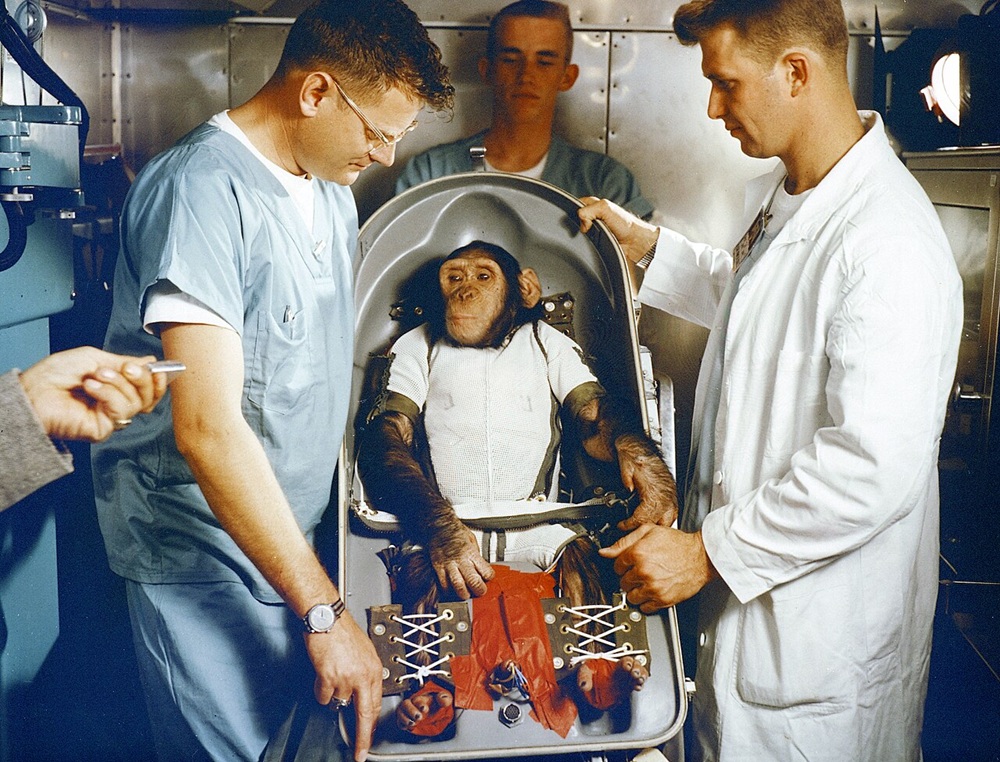
Credit: Photo: Ham the Chimp was the first primate launched into space in 1961. NASA retired Ham in 1963 and he was transferred to the National Zoo in Washington, D.C., where he lived for 17 years before being relocated to the North Carolina Zoo in Asheboro in 1980.