Washington State Life Science Research Funding, 2000-2025
Washington State Life Science Research Funding 2000-2025
By: Phil Ness, LifeScienceHistory.com
Life Science research in the U.S is funded through a variety of sources ranging from the National Institutes of Health (NIH), private non-profit organizations, and philanthropists to private investors, venture financing, and capital markets. Washington State’s life science industry, like other leading U.S. life science centers, was founded in large part on NIH funded research conducted at the state’s universities and non-profit research institutions.
Additionally, the New England Journal of Medicine reported that over 90% of US life science companies have some form of relationship with academic institutions, with approximately 59% formally supporting university research or having active research agreements.
The state of Washington is home to a growing life science industry that includes nearly 500 companies, sixty percent more than in 2015, the last time this report was published. More than one-quarter are founded on technology from the state’s non-profit research organizations and universities, same as that reported in 2015. (Data Source: LSH Database, 1980-2026).
Washington’s life science industry, like many other U.S. life science research centers, was founded on visionary political leadership, specifically that of Senators Warren Magnuson and Henry Jackson who represented their state in the U.S. Congress for a combined total of eighty-nine years (1934-1983). Nicknamed the “Gold Dust Twins” for their ability to obtain federal funding, their rise to seniority leadership in Congress resulted in a growing stream of federal dollars into Washington state, and the Pacific Northwest, that continues to have a significant economic impact today.
This report focuses on life science research in the state of Washington that has been funded through non-profit and university sponsored grants, contracts and federal research and training awards for the period from 2000-2025.
Notably, this period was far from economic stability. Financial calamities included the Great Recession from 2007-2009; the Budget Sequestration of 2013; and the COVID-19 pandemic from 2020-2023 that brought global devastation from an infectious disease not seen since the Great Influenza Pandemic of 1918. The latter required Government at all levels to activate emergency plans supported with unprecedented federal and state funding to prevent the disease from spreading, and to develop diagnostics, therapeutics and vaccines to combat the disease.
Today, more than two dozen non-profit research institutions and universities in Washington state are engaged in life science research. This report includes data from the state’s two largest universities: the University of Washington (UW), and Washington State University (WSU), and the state’s two largest non-profit research organizations: the Fred Hutchinson Cancer Research Center (FHCRC), and the Pacific Northwest National Laboratory (PNNL).
During FY 2025, the University of Washington, Washington State University, Fred Hutchinson Cancer Research Center, and the Pacific Northwest National Laboratory together brought $4.5 billion in grant and contract awards into the state of Washington, the same level these institutions received in FY 2024. Since 2000, these institutions combined have brought more than $75 billion into the state.
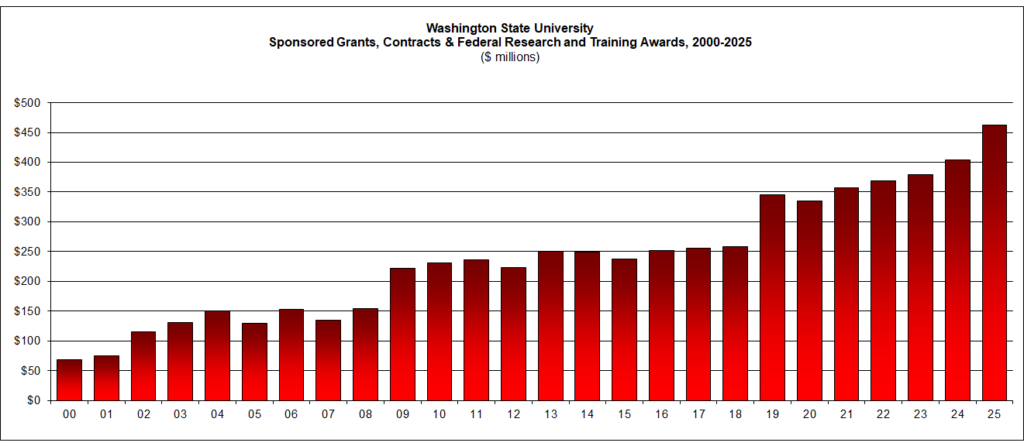
During the FY ending June 30, 2025, WSU received $461.9 million in sponsored grants, contracts and federal research and training awards, an increase of 14.5% or $58.5 million from the $403.4 million received in FY 2024, the fifth straight year of growth.
More than half of the 2025 research expenditures — $224 million — came from federal grants. WSU’s research was also funded by institutional spending ($90.5 million), state and local grants ($119.7 million), nonprofits ($12.4 million) and businesses ($12.8 million). Institutional expenditures underscore WSU’s strong internal commitment to research, supporting innovation, infrastructure, and its role as a leading public research university (WSU Annual Report, 2025).

Fred Hutchinson Cancer Research Center: The Fred Hutch Cancer Center, founded in 1975, is provides the latest cancer treatment options and is known for breakthroughs impacting both cancer and infectious diseases worldwide. Fred Hutch is an independent organization that also serves as the cancer program for UW Medicine.
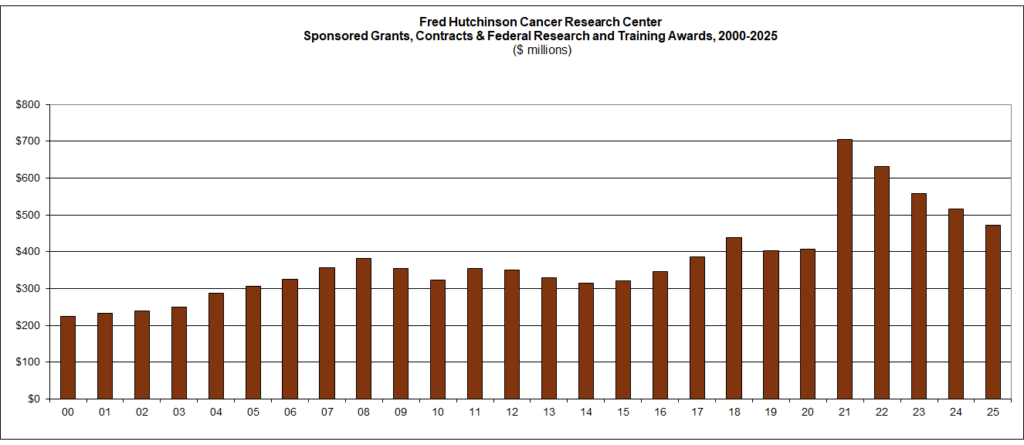
In FY 2025, the FHCRC received $472.1 million in sponsored grants, contracts and federal research and training awards, a decrease of $44.2 million or -8.5% from the $516.3 million received in FY 2024. Since 2000, the FHCRC has received a total of $9.8 billion in total grant and contract awards.
University Sponsored Grants, Contracts & Federal Research and Training Awards, 2000-2025
The state’s two largest universities, the University of Washington (UW) in Seattle, and Washington State University (WSU) in Pullman, have together attracted more than $39.3 billion in grants, contracts & federal research and training awards into the state since 2000.
During the fiscal year (FY) ending June 30, 2025, the UW and WSU received a total of $2.47 billion in total grant and contract awards, an increase of $320 million or 14.8% compared with the $2.15 billion received in FY 2024. It should be noted that the university grants and contract award data is all inclusive, and not life science specific, but is representative of broad research funding.
U.S. National Science Foundation, Top Ten Total R&D Expenditures by University, 2024
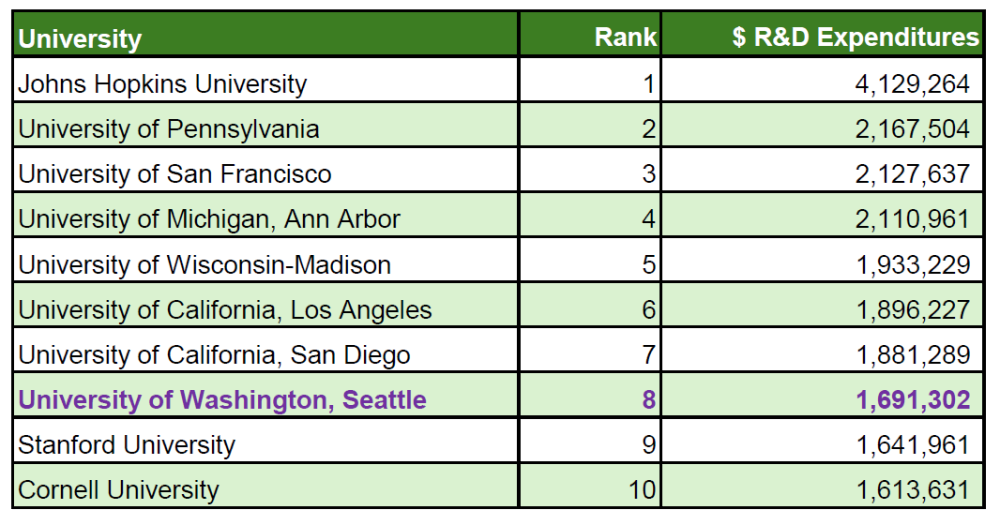
University of Washington (UW) – Since 1974, the UW has been one of the largest public university recipients of federal research funding in the U.S. and is currently ranked eighth in the nation, a drop in rankings from previous years.
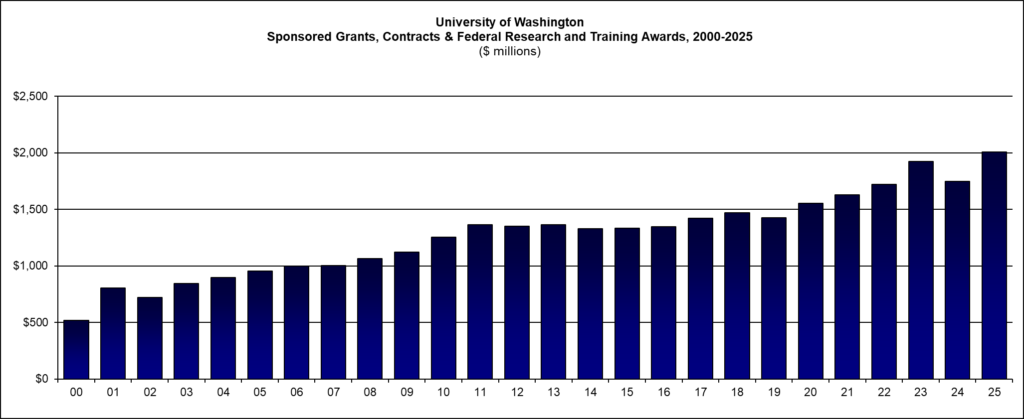
During the FY ending June 30, 2025, the UW received $2.0 billion in sponsored grants, contracts and federal research and training awards, an increase of $260 million or 14.8% or from the $1.747 billion received in FY 2024.
One of the largest sources of UW revenue continues to be grants and contracts at 19%. Grant and contract revenue is received from federal sponsors, which is the largest component, and also from state, local and nongovernmental sources (UW Annual Report, 2025).

Washington State University (WSU) – A land grant institution, WSU is one of the nation’s leading research universities offering programs in agricultural and veterinary medicine, and have received national recognition for work in bioenergetics, high yield wheat, and disease control. WSU also offers extensive programs in biochemistry, molecular science, environmental science and engineering, and wood materials engineering.
The National Institutes of Health, 1940-2026
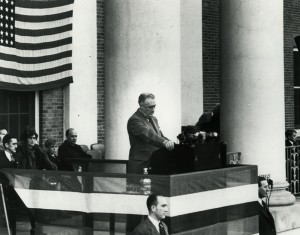
In 1940, President Franklin Roosevelt dedicated the first six buildings of the National Institutes of Health (NIH) which marked a turning point in federal medical research in the United States. During World War II, the NIH focused almost entirely on war-related problems. Significant contributions during the war included the development of blood substitutes and preservatives, sulfa drugs, and antimalarials, such as chloroquine, and penicillin.
Following clinical trials in 1941, mass production of penicillin in the U.S. allowed for widespread military use. By 1943, penicillin was available in sufficient quantities for treating serious infections on the front lines. By the time of the D-Day invasion on June 6, 1944, it was already a staple for treating injured Allied troops. The drug treated wound infections, pneumonia, and sepsis, reducing bacterial infection deaths in soldiers by roughly 15% (Source: Institute of Biomedical Science).
When the wartime Committee on Medical Research (CMR) was disbanded in 1946, the NIH absorbed its contracts and developed a large-scale “extramural” program to fund research at colleges and universities. This shifted the NIH from only conducting internal research to supporting a national research network.
This growth, fueled by the success of wartime research, particularly in pharmaceuticals like penicillin, lead to a new model of government-supported scientific innovation designed to improve public health and bolster the economy. Since 1954, the NIH has been the nation’s medical research agency, and the leading supporter of medical research in the world.
Non-Profit Organization Sponsored Grants, Contracts & Federal Research and Training Awards, 2000-2025
The state’s two largest non-profit research organizations: the Fred Hutchinson Cancer Research Center (FHCRC) and the Pacific Northwest National Laboratory PNNL), combined have since 2000 attracted more than $36.1 billion in grants, contracts & federal research and training awards into the state.
During the fiscal year (FY) ending June 30, 2025, the FHCRC and PNNL received a total of $2.15 billion in total grant and contract awards, the same budget level received in FY 2024.
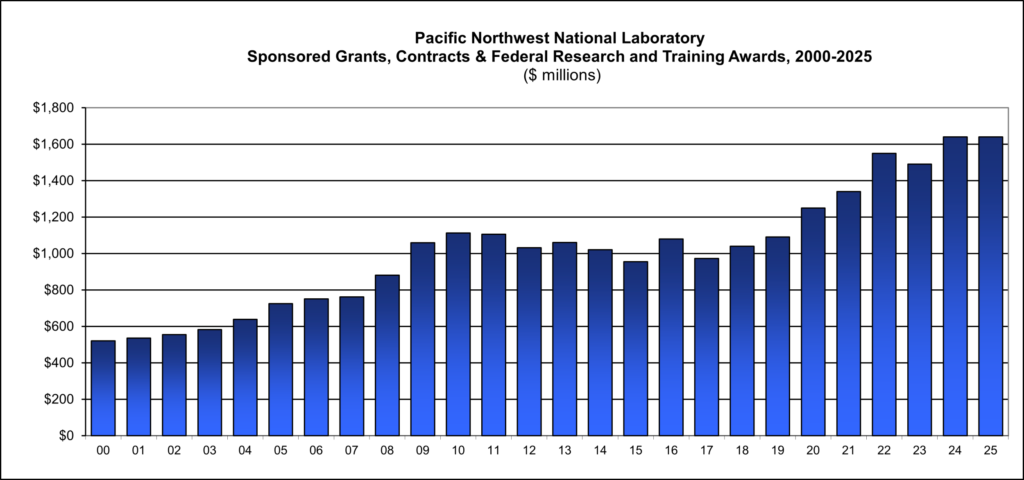
Pacific Northwest National Laboratory: Founded in 1965, the Pacific Northwest National Laboratory (PNNL) is operated by Battelle and supported by the Office of Science of the U.S. Department of Energy. The PNNL is a leading center for scientific discovery in chemistry, data analytics, and Earth science, and for technological innovation in energy resilience and national security.
In FY 2025, the PNNL received $1.64 billion in sponsored grants, contracts and federal research and training awards, maintaining the same level received in FY 2024. Since 2000, the PNNL has received a total of $26.3 billion in total grant and contract awards.
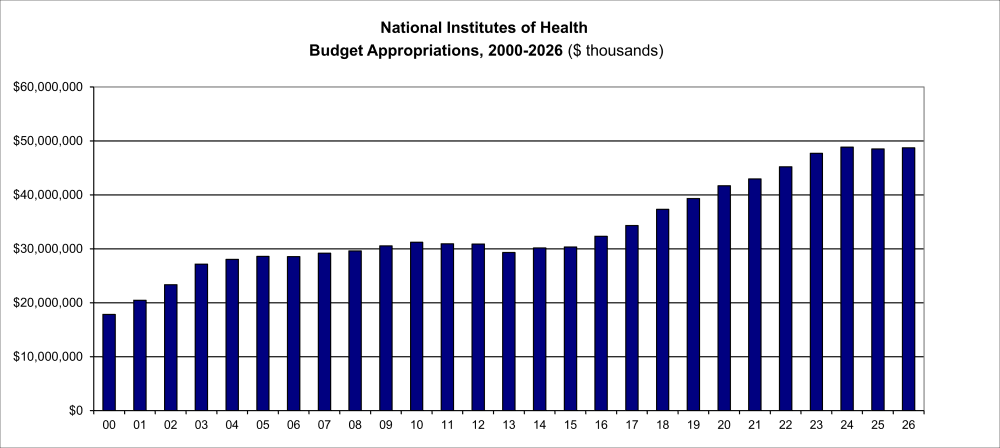
Budget Appropriations Today
Fast forward 70 plus years. On May, 2, 2025, the Trump Administration submitted it’s FY 2026 budget proposal which included a total NIH program level of $27.9 billion, a 42% reduction from the prior year, signaling a major shift in funding priorities. With the NIH budget cuts are proposed policies, including a 15% spending cap on indirect costs, further harming already stretched budgeting with increased laboratory costs, infrastructure, and staff.
The immediate impact included the replacement of long-serving agency leadership with temporary leadership through forced resignations, mass reductions in force (RIFs), eliminated and restricted budgets, and facility closures. An example is the closure of the National Institute of Allergy and Infectious Diseases’ (NIAID) Integrated Research Facility at Fort Detrick, Maryland in June 2025—one of the few federal labs authorized to study Ebola under biosafety level 4 (BSL-4) conditions.
In March, 2025, the Health and Human Services secretary announced that 10,000 people across the federal health agency would lose their jobs, including those at the National Institutes of Health (NIH), Food and Drug Administration (FDA), and Centers for Disease Control and Prevention (CDC).
In April, 2025, the National Center for HIV, Viral Hepatitis, STD, and Tuberculosis Prevention announced the closure of the country’s premier testing laboratory for viral hepatitis. An estimated 4 million Americans are infected with hepatitis C, a disease that can go undetected for years. Another 2.4 million people in this country are chronically infected with hepatitis B, which is a leading cause of liver cancer.
On Oct. 11, 2025, the HHS Secretary announced the dismissal of more than 1,000 scientists, doctors and public health officials from the Department of Health and Human Services. These and other actions resulted in countless lawsuits that are currently working their way through the federal court system.
On Feb. 3, 2026, Congress enacted legislation that provides $47.2 billion in NIH funding, ending a two-day government shutdown with a vote of 217 to 214 in the House. This bipartisan legislation represents a slight increase over FY2025 levels, rejecting the administrations proposed steep cuts to biomedical research. The budget also rejected the proposed 15% spending cap on indirect costs that had threatened lab operations.
Unfortunately, the effects of the initial budget cuts, staff reductions and facility closures are difficult to reverse. The effected and their families have moved on, and an increasing number have taken their research expertise overseas.
Additionally, new immigration restrictions, country suspensions, and increased H-1B visa application fees have resulted in a disruption of research labs, staff, and supply chains. Following the federal lead, Florida and Texas froze H-1B hiring at all public universities. Moreover, the U.S. is now experiencing an out-migration of scientific talent in the STEM fields for the first time in the nation’s history.
European Union nations, Canada, China and Japan have all opened their doors
European Union nations, Canada, China and Japan have all opened their doors, and are actively recruiting leading scientists from the U.S., another first in our nation’s history. These same nations have all increased their funding for scientific research while the U.S. is reducing financial support. The long-term impact to science research and the U.S. economy is unknown.
To further complicate matters, the Trump Administration’s proposed 2027 budget includes $41 billion for the NIH, a $5 billion reduction, and reduces the number of its institutes and centers from 27 to 22, similar to that requested in the 2026 budget.
Fortunately, the foundation that has made the state of Washington one of the nations leading life science centers has not changed, and the building blocks laid by Senators Magnuson and Jackson, and others remain strong.
The University of Washington, Washington State University, Fred Hutchinson Cancer Research Center, and the Pacific Northwest National Laboratory, and other non-profit research institutions, like the Allen Institutes, Gates Foundation, Institute for Systems Biology, Seattle Children’s Research Institute and others are leading centers for research, innovation, new company formation, and job creation in the state, region and nation. Federal research and training awards from the NIH will continue, although at what level remains a question.
On April 7, 1976, the date of Genentech’s founding, China was struggling from the impacts of the Cultural Revolution, leadership changes, and a stagnant agrarian economy. Since then, the nation had modernized economically and technologically on a scale never before seen.
Today, while the U.S. Administration is proposing to reduce R&D investment, and proceed down an uncertain path, China is rapidly moving forward. According to the Organisation for Economic Co-operation and Development (OECD), China has officially crept past the U.S. in total research and development (R&D) investment. According to the OECD, China’s leapfrog actually occurred in 2024, the most recent year for which data are available. That year, China invested $1.03 trillion (in current dollar value) in research and development from all sources, topping the United States’ $1.01 trillion investment.
Our nation is at a major turning point. Only time will tell whether the damage done to date can be corrected, and whether the U.S. Congress will act to restore the nations global leadership position.